Mangroves and brackishwater pond culture in the Philippines
Share
Abstract
Around 50% of mangrove loss in the Philippines can be traced to brackishwater pond construction. The decrease in mangroves from 450 000 ha in 1920 to 132 500 ha in 1990 has been accompanied by expansion of culture ponds to 223 000 ha in 1990. The history of fishpond development in the country includes a government-sponsored fishpond boom in the 1950-g and 1960s, the proconservation decade of the 1970s followed by a shrimp fever in the 1980s. Production from brackisshwater ponds has increased from 15 900 mt worth P7.6 million in 1938 to 267 000 mt valued at P6.5 billion in 1990. On the other hand, the maximum valuation of over $11 000 ha−1 yr−1 for unmanaged and managed mangrove forests makes them economically on par with the most profitable pond farming systems. The loss of mangrove systems and their varied goods and services is the single most important consequence of brackishwater pond culture in the Philippines. Moreover, intensive shrimp farming is associated with other ecological and socioeconomic effects such as pollution of coastal waters and decline in domestic food crops. New legislation and enforcement of existing laws, conservation of remaining mangroves, massive rehabilitation of denuded mangrove areas, and promotion of sustainable aquaculture and fisheries are recommended.
Suggested Citation
Primavera, J. (1995). Mangroves and brackishwater pond culture in the Philippines. Hydrobiologia , 295(1-3), 303-310. https://doi.org/10.1007/BF00029137
Subject
Collections
- AQD Journal Articles [1249]
Related items
Showing items related by title, author, creator and subject.
-
The Philippine aquaculture industry
(Aquaculture Department, Southeast Asian Fisheries Development Center, 1988)The aquaculture sector of the Philippine fishing industry registered the highest growth rate of 12.5% in 1977-1986. The contribution of aquaculture to the total fish production was equivalent to 24% in 1986 compared to ... -
Aquaculture in Malaysia
(Aquaculture Department, Southeast Asian Fisheries Development Center, 1995)Aquaculture in Malaysia is experiencing rapid growth. Total production in 1992 amounted to 79,699 tons valued at RM 207.4 million. These figures are 23% and 25% higher than the previous year's. Semi-culture of the cockle ... -
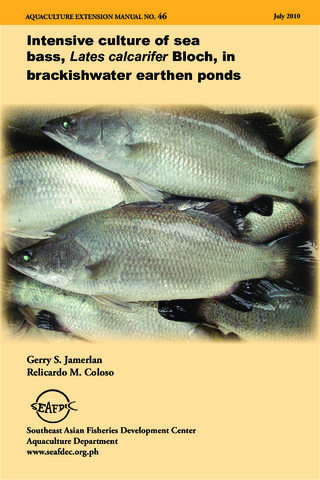
Intensive culture of sea bass, Lates calcarifer Bloch, in brackishwater earthen ponds
(Aquaculture Department, Southeast Asian Fisheries Development Center, 2010)An extension manual describing criteria for site selection, monoculture and polyculture operations including feeds and feeding, harvest, common diseases, economic analysis.