Mud crab hatchery and grow-out status in the Philippines
Share
Abstract
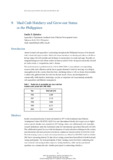
Interest in mud crab aquaculture is increasing throughout the Philippines because of its demand both in local and export markets. Mud crab culture started as low-density polyculture with fish or shrimp using wild crab juveniles and developed to monoculture in ponds and cages. Recently, an integrated mangrove-crab culture system has been practiced. Mud crab species commonly cultured are Scylla serrata, S. tranquebarica, and S. olivacea.
The yearly increase in production from 1996 to 2000 (Table 1) may indicate a corresponding increase in the seed collection activity due to greater demand of seeds for stocking. According to many gatherers in the country, there has been a declining volume of all size-classes, from juveniles to adult crabs, gathered from the wild over the last decade. Hence, the development of a commercially viable hatchery technology can play an important role in promoting sustainable crab aquaculture and fisheries management.
Suggested Citation
Quinitio, E. T. (2004). Mud crab hatchery and grow-out status in the Philippines. In G. Allan & D. Fielder (Eds.), Mud crab aquaculture in Australia and Southeast Asia. Proceedings of the ACIAR Crab Aquaculture Scoping Study and Workshop 28–29 April 2003, Joondooburri Conference Centre, Bribie Island (pp. 53-56). Canberra, Australia: Australian Centre for International Agricultural Research.
Paksa

Mga koleksyon
Related items
Showing items related by title, author, creator and subject.
-
Larval rearing of mud crab (Scylla): What lies ahead
(Elsevier, 2018)The increasing global demand for mud crabs (genus Scylla) and threats to the wild populations highlight the urgency of fully rearing them in captivity. Despite considerable progress in mud crab production, most crab farms ... -
Mud crab pond and pen culture
(University of the Philippines Aquaculture Society, Inc, 2001) -
Updates on the seed production of mud crab
(Aquaculture Department, Southeast Asian Fisheries Development Center, 2015)Widespread interest in mud crab species is increasing because these are highly prized both in domestic and export markets. Among the three mud crab species commonly found in the Philippines, Scylla serrata, S. olivacea, ...