Developments in mollusc farming in Southeast Asia
Share
Abstract
Southeast Asia has a relatively long tradition in mollusc culture. The mollusc species of commercial significance in this region are the blood cockles (Anadara granosa), the green mussels (Perna viridis), the oysters (Crassostrea spp.) and the horse mussels (Modiolus sp.). Mollusc production has been observed to fluctuate dramatically in recent years due mainly to the inconsistent seed supply from the wild, which varies geographically and annually. These variations are often associated with pollution and also the uncontrolled harvesting of adults irrespective of their sizes, which reduces chances of spawning among adults. Production of the above-mentioned species in Southeast Asia in 1997 amounted to 73 820, 62 073, 36 779 and 5 300 mt., respectively. The culture of these bivalves is still dependent on traditional methods of obtaining seeds from the wild and transplanting them to culture sites for grow-out. Culture techniques for these bivalves are basically the same all over Southeast Asia, except for minor variations in the use of structures and materials to suit the local conditions. Whilst efforts are geared towards developing new technologies to promote mollusc culture in the region, it is important to facilitate and stimulate environmentally acceptable developments and sustainable management practices. Although hatchery propagation techniques have been developed for these cultured and other non-cultured species, the technologies have yet to be taken up commercially. Some of the common problems confronted by the region, which varies greatly by species and location, are inconsistent seed supply, lack of suitable areas for expanding culture activities, poor post harvest handling techniques, demand levels being below production capacity, environmental pollution, vagaries of nature, low price and lack of access to export markets.
Suggested Citation
Nair, D. M. (2001). Developments in mollusc farming in Southeast Asia. In L. M. B. Garcia (Ed.), Responsible Aquaculture Development in Southeast Asia. Proceedings of the Seminar-Workshop on Aquaculture Development in Southeast Asia organized by the Aquaculture Department, Southeast Asian Fisheries Development Center, 12-14 October 1999, Iloilo City, Philippines (pp. 103-114). Tigbauan, Iloilo, Philippines: Aquaculture Department, Southeast Asian Fisheries Development Center.
Paksa

Mga koleksyon
- ADSEA '99 [21]
Related items
Showing items related by title, author, creator and subject.
-
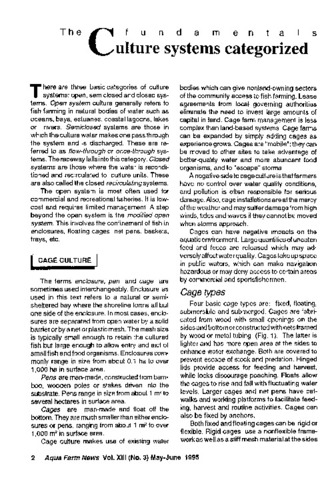
Culture systems categorized: The fundamentals
(Aquaculture Department, Southeast Asian Fisheries Development Center, 1995)The article presents the three basic categories of culture systems: open, semiclosed and closed systems. Open system culture generally refers to fish farming in natural bodies of water such as oceans, bays, estuaries, ... -
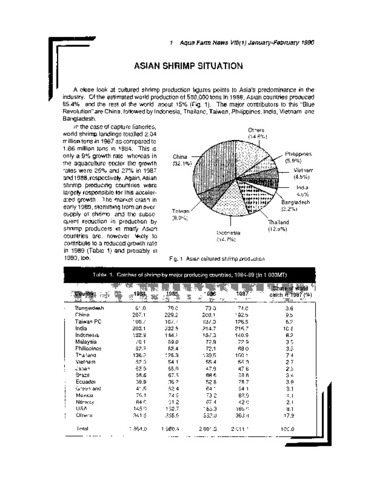
Asian shrimp situation
(Aquaculture Department, Southeast Asian Fisheries Development Center, 1990) -
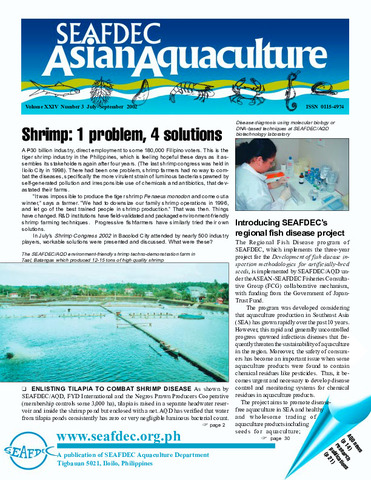
Shrimp: 1 problem, 4 solutions
(Aquaculture Department, Southeast Asian Fisheries Development Center, 2002)