Bioremediation of oil spills: Current status, challenges, and future prospects
Associated URL
office2.jmbfs.orgNgày
2024-03-22Page views
851metadata
Hiển thị bản ghi đầy đủ mặt hàngCited times in Scopus
Share
trừu tượng
The petrochemicals produced from refining oil have become a large part of human life, making oil a valuable and expensive commodity. As a non-renewable resource, extraction and transport efforts have intensified to keep up with the demand, increasing the occurrences of oil spills. Such accidents have devastating impacts on the environment, the health of organisms, and a country's economy like the Philippines, and thus, need to be resolved immediately. One way to deal with oil spills is through bioremediation but the process is still facing several challenges. For one, the toolbox for bioremediation is limited. About 79 genera of bacteria were observed to degrade oil but there are only a small number of bacterial species and/or strains that have been recognized as useful for bioremediation. Second is that most oil-degrading bacteria found have low oil degradation efficiencies. Another challenge is keeping the bacteria alive to carry out the process. Fortunately, progress has been made in solving these challenges. Researchers are now testing different consortia, including bacteria–bacteria, bacteria–fungi, bacteria–microalgae, that can complement each other such as biosurfactant-producing bacteria with different oil-degrading microorganisms or microalgae or fungi that enhance the growth of oil-degrading bacteria. A consortium like this improves the survivability of each microorganism and enhances the oil-degrading efficiency. Moreover, the search for additional oil-degrading and biosurfactant-producing bacteria and other microorganisms to add to the bioremediation toolbox has been improved with the emergence of high-throughput sequencing. Aside from microorganisms, seaweeds have shown potential for bioremediation. The seaweed Caulerpa prolifera has been demonstrated to degrade diesel up to a certain concentration with the help of the bacteria growing on its surface. Bioremediation has a long way to go, but recent developments have shown promise and it remains to be the cheapest, most environment-friendly, and most effective way of dealing with oil spills.
Suggested Citation
Navarro, J., & Caipang, C. M. (2024). Bioremediation of oil spills: Current status, challenges, and future prospects. Journal of Microbiology, Biotechnology and Food Sciences , 13(6), e10450. https://doi.org/10.55251/jmbfs.10450
Chủ thể
Bộ sưu tập
- AQD Journal Articles [1249]
Related items
Showing items related by title, author, creator and subject.
-
Initial assessment of the bacterial population of Guimaras waters and soil after the Solar I oil spill
(University of the Philippines Visayas, 2009)A massive oil spill occurred near the shores of Guimaras Island, Philippines in 11 Aug 2006 caused by the Sunken MT Solar I vessel. The oil spill spread to neighboring towns of Guimaras damaging the marine coastal environment, ... -
Adsorption and biomass concentration of thraustochytrid Schizochytrium aggregatum (Goldstein and Belsky) in Bunker C Oil
(School of Environmental Science and Management, University of the Philippines Los Baños, 2014)Diverse array of microorganisms such as bacteria, fungi and protists are involved during oil spill. Each microorganism has its own specific function whether it has to degrade or adsorb hydrocarbons. One important microorganism ... -
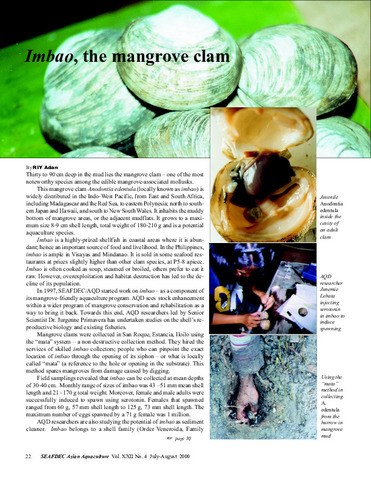
Imbao, the mangrove clam
(Aquaculture Department, Southeast Asian Fisheries Development Center, 2000)