Milkfish marketing in the Philippines
Share
abstrak
Milkfish produced from aquaculture is one of the most traded fish in local markets and it also provides export earnings for the Philippines. Annual per capita consumption of milkfish among Filipinos is 4 kg which comprise the major portion of the 25 kg annual intake of all types of fresh fish. Increasing milkfish production from aquaculture constitutes the strategies for securing fish food supply, especially for the growing middle- and low-income households. However, there are diverging analyses and criticisms on the effectiveness and performance of the milkfish industry in improving access to fish and protein sources among the poor in the Philippines. The generally increasing volumes of milkfish production due to improved technologies are indeed desirable. But higher levels of production does not guaranty the availability and access to fish food supply, especially in geographically dispersed production and consumption centers around the archipelago. Efficiency in marketing perishable fishery products is a crucial factor to ensure availability of safe and fresh milkfish in deficit areas. This review of milkfish marketing literature showed that meeting the milkfish demand-supply gaps, in geographic and temporal sense, is an immediate market objective for the Philippines. The spatial and inter-temporal variations in production volumes influence investment decisions on infrastructures and other public support systems. There is enormous challenge for the industry in view of the declining productivity of capture fisheries, the emerging preference for organic food and value-added forms arising from socio-cultural transformations and lifestyle changes among consumers. This chapter elaborates on the potentials of the milkfish industry by presenting the challenges for traders who should deal with the issues on the demand side of the market; and the challenges for milkfish farmers and processors who should act on the supply side. The constraints and corresponding strategies to meet potentials are also discussed.
Suggested Citation
Salayo, N. D. (2010). Milkfish marketing in the Philippines. In I. C. Liao & E. M. Leaño (Eds.), Milkfish aquaculture in Asia (pp. 105-127). Keelung, Taiwan: National Taiwan Ocean University, The Fisheries Society of Taiwan, Asian Fisheries Society and World Aquaculture Society.
Subjek
fishery products  ; marketing ; aquaculture ; trade ; costs ; fish ; foods ; milkfish ; Philippines ; supply balance ; markets ; exports ; prices ; food supply ; organic foods
; marketing ; aquaculture ; trade ; costs ; fish ; foods ; milkfish ; Philippines ; supply balance ; markets ; exports ; prices ; food supply ; organic foods
Koleksi
Related items
Showing items related by title, author, creator and subject.
-
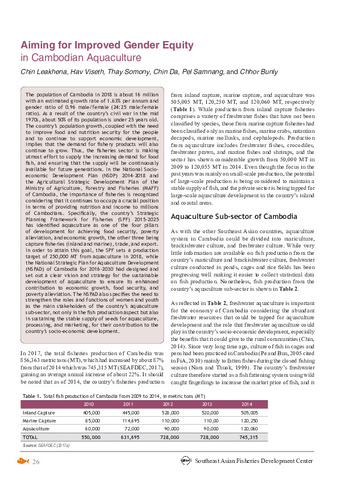
Aiming for improved gender equity in Cambodian aquaculture
(Secretariat, Southeast Asian Fisheries Development Center, 2018)The population of Cambodia in 2018 is about 16 million with an estimated growth rate of 1.63% per annum and gender ratio of 0.96 male/female (24:25 male:female ratio). As a result of the country’s civil war in the mid ... -
'No' to cyanide fishing!
(Aquaculture Department, Southeast Asian Fisheries Development Center, 1999) -
Socioeconomics of tilapia culture in Asia
(Aquaculture Department, Southeast Asian Fisheries Development Center, 1998)