SEAFDECINSTITUTIONAL REPOSITORY
    • English
    • ไทย
    • 日本語
    • Bahasa Indonesia
    • Bahasa Melayu
    • Burmese
    • Filipino
    • Khmer
    • Lao
    • Tiếng Việt
  • Tiếng Việt 
    • English
    • ไทย
    • 日本語
    • Bahasa Indonesia
    • Bahasa Melayu
    • Burmese
    • Filipino
    • Khmer
    • Lao
    • Tiếng Việt
  • Đăng nhập
Xem mặt hàng 
  •   Trang chủ DSpace
  • 08 SEAFDEC/MFRD Publications
  • 02 Technical Publications and Reports on Fish Handling and Post-harvest Practices
  • Enhancing Quality and Safety of Fish Products
  • Hazard Analysis and Critical Control Point (HACCP)
  • Proceedings of the 1st Regional Workshop on the Application of HACCP in the Fish Processing Industry in Southeast Asia, 28 August-1 September 2000, Singapore
  • Xem mặt hàng
  •   Trang chủ DSpace
  • 08 SEAFDEC/MFRD Publications
  • 02 Technical Publications and Reports on Fish Handling and Post-harvest Practices
  • Enhancing Quality and Safety of Fish Products
  • Hazard Analysis and Critical Control Point (HACCP)
  • Proceedings of the 1st Regional Workshop on the Application of HACCP in the Fish Processing Industry in Southeast Asia, 28 August-1 September 2000, Singapore
  • Xem mặt hàng
JavaScript is disabled for your browser. Some features of this site may not work without it.

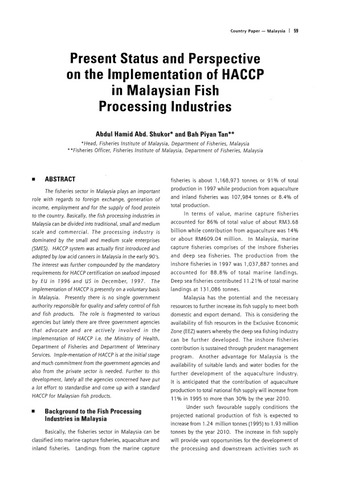
Present status and perspective on the implementation of HACCP in Malaysian fish processing industries
Thumbnail
Quan điểm/Open
PDF Preview
ShukorAHAb2001.pdf (274.2Kb)
Downloads: 324
Ngày
2001
Tác giả
Shukor, Abdul Hamid Abd.
Tan, Bah Piyan
Page views
1,071
metadata
Hiển thị bản ghi đầy đủ mặt hàng

Share 
 
trừu tượng
The fisheries sector in Malaysia plays an important role with regards to foreign exchange, generation of income, employment and for the supply of food protein to the country. Basically, the fish processing industries in Malaysia can be divided into traditional, small and medium scale and commercial. The processing industry is dominated by the small and medium scale enterprises (SMES). HACCP system was actually first introduced and adopted by low acid canners in Malaysia in the early 90's. The interest was further compounded by the mandatory requirements for HACCP certification on seafood imposed by EU in 1996 and US in December, 1997. The implementation of HACCP is presently on a voluntary basis in Malaysia. Presently there is no single government authority responsible for quality and safety control of fish and fish products. The role is fragmented to various agencies but lately there are three government agencies that advocate and are actively involved in the implementation of HACCP i.e. the Ministry of Health, Department of Fisheries and Department of Veterinary Services. Implementation of HACCP is at the initial stage and much commitment from the government agencies and also from the private sector is needed. Further to this development, lately all the agencies concerned have put a lot effort to standardise and come up with a standard HACCP for Malaysian fish products.
URI
http://hdl.handle.net/20.500.12066/4486
Suggested Citation
Shukor, A. H. A., & Tan, B. P. (2001). Present status and perspective on the implementation of HACCP in Malaysian fish processing industries. In S. E. Yeap & T. N. Kok (Eds.), Proceedings of the 1st Regional Workshop on the Application of HACCP in the Fish Processing Industry in Southeast Asia, 28 August-1 September 2000, Singapore (pp. 59-65). Singapore: Marine Fisheries Research Department, Southeast Asian Fisheries Development Center.
Chủ thể
Malaysia
Bộ sưu tập
  • Proceedings of the 1st Regional Workshop on the Application of HACCP in the Fish Processing Industry in Southeast Asia, 28 August-1 September 2000, Singapore [15]

© SEAFDEC 2025
Liên hệ chúng tôi


Duyệt qua

Tất cả DSpaceCộng đồng & Bộ sưu tậpTheo ngày phát hànhCác tác giảTiêu đềĐối tượngBộ sưu tập nàyTheo ngày phát hànhCác tác giảTiêu đềĐối tượng

Tài khoản của tôi

Đăng nhập
Related Links
SEAFDEC/TD IRSEAFDEC/AQD IRSEAFDEC/MFRDMD IRSEAFDEC/IFRDMD IR

© SEAFDEC 2025
Liên hệ chúng tôi


DOWNLOAD