Breeding and larval rearing of the milkfish Chanos chanos (Pisces: Chanidae)

Share
Abstract
Two sexually maturing female milkfish were captured in April 1977 and induced to spawn by means of acetone-dried Pacific salmon pituitary powder. The eggs were fertilized and incubated and the resultant young reared to 74-day old, 11 cm long fingerlings. Newly fertilized eggs averaged 1.16 mm in diameter and each had a narrow perivitelline space containing several cortical granules which disappeared within a few minutes. The yolk was slightly yellowish, devoid of oil globules and very finely granulated. Embryonic development was very similar to that of other pelagic fish eggs and hatching occurred between 35 to 36 hr at a salinity of 32 ppt and a temperature range of 28.4-29.2°C.
Description
Contribution No. 11 of the Aquaculture Department, Southeast Asian Fisheries Development Center, P.O. Box 256, Iloilo City 5901, Philippines.
Suggested Citation
Vanstone, W. E., Tiro, L. B. J., Villaluz, A. C., Ramsingh, D. C., Kumagai, S., Dulduco, P. J., … Dueñas, C. E. (1977). Breeding and larval rearing of the milkfish Chanos chanos (Pisces: Chanidae). In: Induced spawning, artificial fertilization of eggs and larval rearing of the milkfish Chanos chanos (Forskal) in the Philippines (Technical Report No. 3) (pp. 1-17). Tigbauan, Iloilo, Philippines: Aquaculture Department, Southeast Asian Fisheries Development Center.
Subject

Taxonomic term

Collections
Related items
Showing items related by title, author, creator and subject.
-
Small-scale freshwater aquaculture development: Experiences from the Philippines on giant freshwater prawn, milkfish and tilapia
(Japan International Cooperation Agency, 2013-12)The Aquaculture Department of the Southeast Asian Fisheries Development Center (SEAFDEC/AQD) has been promoting a number of programs towards effective dissemination and adoption of science-based aquaculture technologies ... -
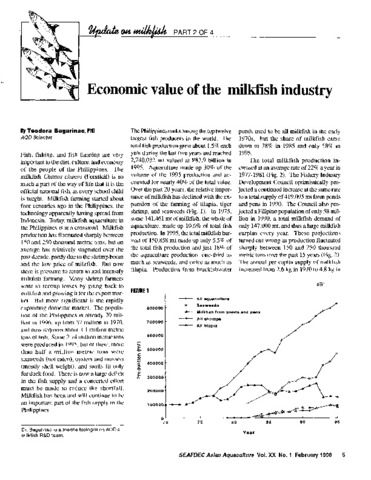
Economic value of the milkfish industry
(Aquaculture Department, Southeast Asian Fisheries Development Center, 1998)A brief description is given of the milkfish (Chanos chanos) farming industry in the Philippines. Over the past 20 years, the relative importance of milkfish has declined with the expansion of tilapia, tiger shrimp and ... -
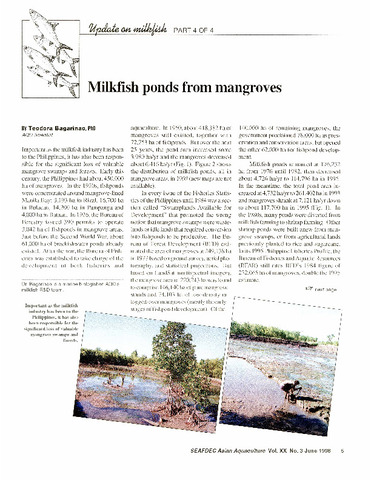
Milkfish ponds from mangroves
(Aquaculture Department, Southeast Asian Fisheries Development Center, 1998)