SEAFDECINSTITUTIONAL REPOSITORY
    • English
    • ไทย
    • 日本語
    • Bahasa Indonesia
    • Bahasa Melayu
    • Burmese
    • Filipino
    • Khmer
    • Lao
    • Tiếng Việt
  • ไทย 
    • English
    • ไทย
    • 日本語
    • Bahasa Indonesia
    • Bahasa Melayu
    • Burmese
    • Filipino
    • Khmer
    • Lao
    • Tiếng Việt
  • เข้าสู่ระบบ
ดูรายการ 
  •   SIR บ้าน
  • 08 SEAFDEC/MFRD Publications
  • 02 Technical Publications and Reports on Fish Handling and Post-harvest Practices
  • Fish Handling, Preservation and Utilization
  • Proceedings of the Seminar on the Advances in Fish Processing Technology in Southeast Asia in Relation to Quality Management, Singapore, 29 October - 1 November 1996
  • ดูรายการ
  •   SIR บ้าน
  • 08 SEAFDEC/MFRD Publications
  • 02 Technical Publications and Reports on Fish Handling and Post-harvest Practices
  • Fish Handling, Preservation and Utilization
  • Proceedings of the Seminar on the Advances in Fish Processing Technology in Southeast Asia in Relation to Quality Management, Singapore, 29 October - 1 November 1996
  • ดูรายการ
JavaScript is disabled for your browser. Some features of this site may not work without it.

Colour and quality assessment of tuna for sashimi
Thumbnail
ดู/เปิด
PDF Preview
ChiaEGH1997.pdf (524.8Kb)
Downloads: 368
วันที่
1997
ผู้เขียน
Chia, Evelyn G. H.
Low, Lai Kim
Mori, Yoshishige
Page views
744
เมตาดาต้า
แสดงระเบียนรายการเต็ม

Share 
 
นามธรรม
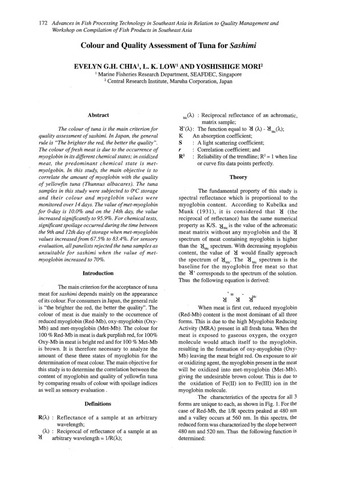
The colour of tuna is the main criterion for quality assessment of sashimi. In Japan, the general rule is The brighter the red, the better the quality . The colour of fresh meat is due to the occurrence of myoglobin in its different chemical states; in oxidized meat, the predominant chemical state is metmyolgobin. In this study, the main objective is to correlate the amount of myoglobin with the quality of yellowfin tuna (Thunnus albacares). The tuna samples in this study were subjected to 0°C storage and their colour and myoglobin values were monitored over 14 days. The value of met-myoglobin for 0-day is 10.0% and on the 14th day, the value increased significantly to 95.9%. For chemical tests, significant spoilage occurred during the time between the 9th and 12th day of storage when met-myoglobin values increased from 67.5% to 83.4%. For sensory evaluation, all panelists rejected the tuna samples as unsuitable for sashimi when the value of met-myoglobin increased to 70%.
URI
http://hdl.handle.net/20.500.12066/4842
การอ้างอิง
Chia, E. G. H., Low, L. K., & Mori, Y. (1997). Colour and quality assessment of tuna for sashimi. In K. K. Hooi, L. K. Low, & P. Y. Lim (Eds.), Proceedings of the seminar on the advances in fish processing technology in Southeast Asia in relation to quality management, Singapore, 29 October - 1 November 1996 (pp. 172-182). Singapore: Marine Fisheries Research Department, Southeast Asian Fisheries Development Center.
คอลเลกชัน
  • Proceedings of the Seminar on the Advances in Fish Processing Technology in Southeast Asia in Relation to Quality Management, Singapore, 29 October - 1 November 1996 [37]

© SEAFDEC 2025
ติดต่อเรา


หมวด

ทั้งหมดของ SIRชุมชนและคอลเล็กชันตามวันที่ออกผู้เขียนชื่อเรื่องอาสาสมัครคอลเลกชันนี้ตามวันที่ออกผู้เขียนชื่อเรื่องอาสาสมัคร

บัญชีของฉัน

เข้าสู่ระบบ
Related Links
SEAFDEC/TD IRSEAFDEC/AQD IRSEAFDEC/MFRDMD IRSEAFDEC/IFRDMD IR

© SEAFDEC 2025
ติดต่อเรา


DOWNLOAD