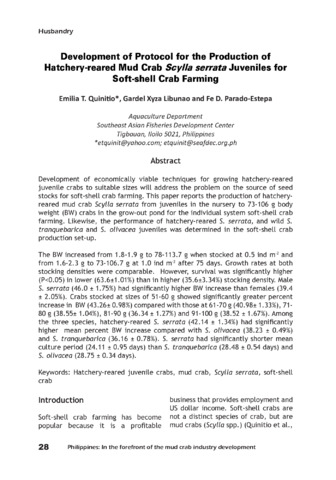
Development of protocol for the production of hatchery-reared mud crab Scylla serrata juveniles for soft-shell crab farming
Share
អរូបី
Development of economically viable techniques for growing hatchery-reared juvenile crabs to suitable sizes will address the problem on the source of seed stocks for soft-shell crab farming. This paper reports the production of hatchery-reared mud crab Scylla serrata from juveniles in the nursery to 73-106 g body weight (BW) crabs in the grow-out pond for the individual system soft-shell crab farming. Likewise, the performance of hatchery-reared S. serrata, and wild S. tranquebarica and S. olivacea juveniles was determined in the soft-shell crab production set-up.The BW increased from 1.8-1.9 g to 78-113.7 g when stocked at 0.5 ind m-2 and from 1.6-2.3 g to 73-106.7 g at 1.0 ind m-2 after 75 days. Growth rates at both stocking densities were comparable. However, survival was significantly higher (P<0.05) in lower (63.6~c1.01%) than in higher (35.6~c3.34%) stocking density. Male S. serrata (46.0 ~c 1.75%) had significantly higher BW increase than females (39.4 ~c 2.05%). Crabs stocked at sizes of 51-60 g showed significantly greater percent increase in BW (43.26~c 0.98%) compared with those at 61-70 g (40.98~c1.33%), 71-80 g (38.55~c 1.04%), 81-90 g (36.34 ~c 1.27%) and 91-100 g (38.52 ~c 1.67%). Among the three species, hatchery-reared S. serrata (42.14 ~c 1.34%) had significantly higher mean percent BW increase compared with S. olivacea (38.23 ~c 0.49%) and S. tranquebarica (36.16 ~c 0.78%). S. serrata had significantly shorter mean culture period (24.11 ~c 0.95 days) than S. tranquebarica (28.48 ~c 0.54 days) and S. olivacea (28.75 ~c 0.34 days).
Suggested Citation
Quinitio, E. T., Libunao, G. X., & Parado-Estepa, F. D. (2017). Development of protocol for the production of hatchery-reared mud crab Scylla serrata juveniles for soft-shell crab farming. In E. T. Quinitio, F. D. Parado-Estepa, & R. M. Coloso (Eds.), Philippines : In the forefront of the mud crab industry development : proceedings of the 1st National Mud Crab Congress, 16-18 November 2015, Iloilo City, Philippines (pp. 28-38). Tigbauan, Iloilo, Philippines: Aquaculture Department, Southeast Asian Fisheries Development Center.
ប្រធានបទ
Taxonomic term
Related items
Showing items related by title, author, creator and subject.
-
Mud crab pond and pen culture
(University of the Philippines Aquaculture Society, Inc, 2001) -
Updates on the seed production of mud crab
(Aquaculture Department, Southeast Asian Fisheries Development Center, 2015)Widespread interest in mud crab species is increasing because these are highly prized both in domestic and export markets. Among the three mud crab species commonly found in the Philippines, Scylla serrata, S. olivacea, ... -
Overview of the mud crab industry in the Philippines
(Aquaculture Department, Southeast Asian Fisheries Development Center, 2017)Mud crab farming has long been established in the Philippines and the country is the second top producer in the world. Except for Scylla paramamosain, the three other species, S. serrata, S. tranquebarica and S. olivacea ...