A review of mangrove rehabilitation in the Philippines: successes, failures and future prospects
Share
စိတ္တဇ
From half a million hectares at the turn of the century, Philippine mangroves have declined to only 120,000 ha while fish/shrimp culture ponds have increased to 232,000 ha. Mangrove replanting programs have thus been popular, from community initiatives (1930s-1950s) to government-sponsored projects (1970s) to large-scale international development assistance programs (1980s to present). Planting costs escalated from less than US$100 to over $500/ha, with half of the latter amount allocated to administration, supervision and project management. Despite heavy funds for massive rehabilitation of mangrove forests over the last two decades, the long-term survival rates of mangroves are generally low at 10-20%. Poor survival can be mainly traced to two factors: inappropriate species and sites selection. The favored but unsuitable Rhizophora are planted in sandy substrates of exposed coastlines instead of the natural colonizers Avicennia and Sonneratia. More significantly, planting sites are generally in the lower intertidal to subtidal zones where mangroves do not thrive rather than the optimal middle to upper intertidal levels, for a simple reason. Such ideal sites have long been converted to brackishwater fishponds whereas the former are open access areas with no ownership problems. The issue of pond ownership may be complex and difficult, but such should not outweigh ecological requirements: mangroves should be planted where fishponds are, not on seagrass beds and tidal flats where they never existed. This paper reviews eight mangrove initiatives in the Philippines and evaluates the biophysical and institutional factors behind success or failure. The authors recommend specific protocols (among them pushing for a 4:1 mangrove to pond ratio recommended for a healthy ecosystem) and wider policy directions to make mangrove rehabilitation in the country more effective.
ဖော်ပြချက်
SEAFDEC main author. CC covered journal. Open Access Journal. Full text available.
Suggested Citation
Primavera, J., & Esteban, J. M. A. (2008). A review of mangrove rehabilitation in the Philippines: successes, failures and future prospects. Wetlands Ecology and Management , 16(5), 345-358. https://doi.org/10.1007/s11273-008-9101-y
ဘာသာရပ်
Taxonomic term
စုစည်းမှုများ စုစည်းမှုများ
- AQD Journal Articles [1249]
Related items
Showing items related by title, author, creator and subject.
-
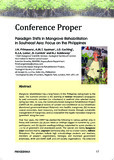
Paradigm shifts in mangrove rehabilitation in Southeast Asia: Focus on the Philippines
(Department of Environment and Natural Resources - Ecosystems Research and Development Bureau (DENR-ERDB), 2014)Mangrove rehabilitation has a long history in the Philippines dating back to the 1930s. The standard practice is the planting of bakhaw Rhizophora propagules by paid community members (or volunteers) in seafront sites ... -
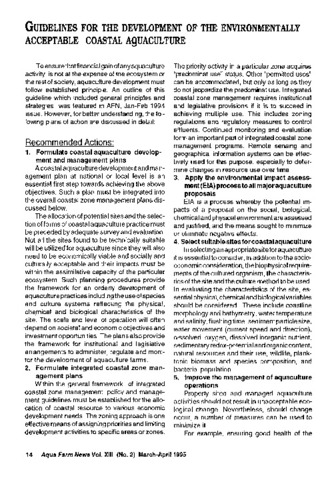
Guidelines for the development of environmentally acceptable coastal aquaculture
(Aquaculture Department, Southeast Asian Fisheries Development Center, 1995)The paper presents some recommendations for the development of the environmentally acceptable coastal aquaculture such as: 1) Formulate coastal aquaculture development and management plans, 2) Formulate integrated coastal ... -
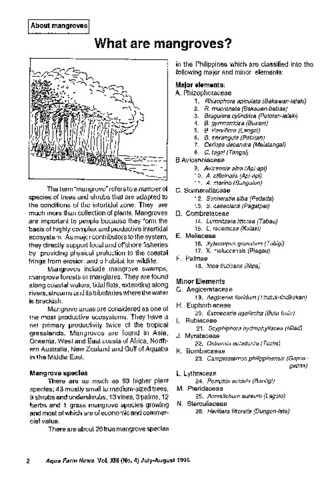
What are mangroves?
(Aquaculture Department, Southeast Asian Fisheries Development Center, 1995)The article presents about mangroves and its value to the ecosystem. The different species in the Philippines and mangroves coping mechanisms to the environment are also presented.