Poly-beta-hydroxybutyrate-enriched Artemia sp. for giant tiger prawn Penaeus monodon larviculture
Quan điểm/
Ngày
2017Page views
841metadata
Hiển thị bản ghi đầy đủ mặt hàngCited times in Scopus
Share
trừu tượng
The beneficial effects of PHB as supplement for giant tiger prawn Penaeus monodon postlarvae using a short-term enrichment strategy via Artemia were examined. The effects of co-supplementing with a lipid emulsion were also evaluated to determine whether it yielded an additional benefit. Results on the average weight and larval development were not significantly different among postlarvae fed the different dietary treatments, indicating that PHB supplementation could not be used to stimulate growth in P. monodon postlarvae while such positive results have been reported in other aquaculture species. Nonetheless, significantly higher survival was obtained in postlarvae fed PHB-enriched Artemia irrespective of lipid enrichment. In addition, PHB increased the survival of the postlarvae after exposure to a lethal dose of ammonia. Lipid supplementation nullified this effect. The cumulative mortality of postlarvae subjected to a sublethal concentration of ammonia for 24 h and subsequent exposure to pathogenic Vibrio campbelli showed that PHB but not lipids could effectively enhance the resistance of the postlarvae. Co-supplementing lipids even significantly decreased this outcome. Our study indicates that PHB supplementation increases the quality of larval P. monodon and their chance of surviving under adverse environmental conditions. The short-term co-supplementation with lipid emulsion did not add to these effects.
Suggested Citation
Ludevese-Pascual, G., Laranja, J. L., Amar, E. C., Sorgeloos, P., Bossier, P., & De Schryver, P. (2017). Poly-beta-hydroxybutyrate-enriched Artemia sp. for giant tiger prawn Penaeus monodon larviculture. Aquaculture Nutrition , 23(2), 422-429. https://doi.org/10.1111/anu.12410
Chủ thể
Taxonomic term
Bộ sưu tập
- AQD Journal Articles [1249]
Related items
Showing items related by title, author, creator and subject.
-
An overview of the nutrition, feed and feeding techniques of prawn penaeid/shrimps
(Philippine Council for Aquatic and Marine Research and Development, 1989)This paper echoes what transpired during the first International Conference of Penaeid Prawns/Shrimps held in Iloilo City in December 4-7, 1984, particularly on the Nutrition nd Feed Development. Around 25 papers were ... -
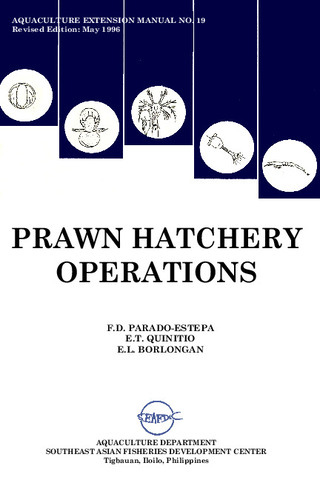
Prawn hatchery operations
(Aquaculture Department, Southeast Asian Fisheries Development Center, 1996-05)The manual, an updated version of the 1984 SEAFDEC/AQD manual, presents the underlying principles and step-by-step instructions of prawn larval and post-larval rearing. The techniques described are not only applicable to ... -
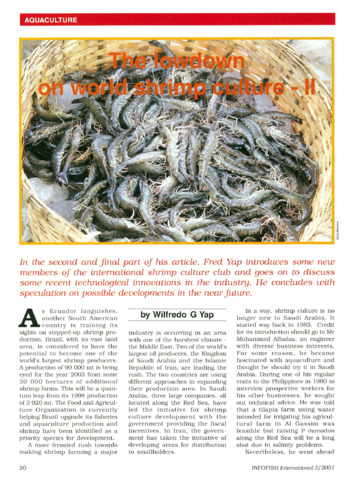
The lowdown on world shrimp culture - II
(INFOFISH, 2001)This paper introduces some new members of the international shrimp culture club and goes on to discuss some recent technological innovations in the industry, particularly the polyculture of tilapia (mainly Oreochromis ...