11 Conference Proceedings: Recent submissions
481-500 / 649
-
Mud crab Scylla serrata hatchery operation
(Aquaculture Department, Southeast Asian Fisheries Development Center, 2017)The initial exposure of the Santos family in aquaculture was the culture of milkfish (Chanos chanos) and mud crab (Scylla serrata) in brackishwater pond in Quezon. The milkfish fry were obtained from our own milkfish ... -
Updates on the larviculture of mud crab at SEAFDEC/AQD
(Aquaculture Department, Southeast Asian Fisheries Development Center, 2017)Although the mud crab (Scylla serrata) hatchery technology has been developed, issues such as high cost of production due to the need for additional facilities and labor for natural food culture, inconsistent survival rate ... -
High throughput RNA sequencing reveals temperature tolerance mechanisms in Scylla serrata
(Aquaculture Department, Southeast Asian Fisheries Development Center, 2017)The effects of increasing temperature from global climate change threaten the sustainability and production of mud crabs from farms and wild populations in mangroves. Adaptation of mud crab populations to temperature stress ... -
Population structure of Scylla serrata from microsatellite and mtDNA markers
(Aquaculture Department, Southeast Asian Fisheries Development Center, 2017)Determination of the population structure and connectivity of natural populations of Scylla serrata are useful tools for decision making related to conservation and management efforts of this species. They provide important ... -
Genetic diversity and stock delineation of Philippine populations of the orange mud crab, Scylla olivacea
(Aquaculture Department, Southeast Asian Fisheries Development Center, 2017)The orange mud crab, Scylla olivacea, is regarded as an important fishery resource due to high demand and high market value. However, mud crab populations are threatened by over exploitation and habitat degradation, and ... -
Identification of mud crab species in coastal areas of Pangasinan
(Aquaculture Department, Southeast Asian Fisheries Development Center, 2017)The study was conducted to identify the mud crab species (Scylla spp.) that thrive in 12 coastal municipalities and 2 cities in Pangasinan. Ten mud crab samples were taken from each of the sampling site and classified based ... -
Recent developments and enhancing transfer of the nursery technology for the mud crab Scylla serrata
(Aquaculture Department, Southeast Asian Fisheries Development Center, 2017)The development of hatchery techniques for seed production of mud crab is expected to address the present problem on the depletion of wild seedstock supply for stocking in grow-out ponds. The nursery serves as the link ... -
Philippine National Standard for Live Mud Crabs: establishing food safety and quality requirements
(Aquaculture Department, Southeast Asian Fisheries Development Center, 2017)The Bureau of Agriculture and Fisheries Standards (BAFS) of the Department of Agriculture (DA), in collaboration with the relevant government and research agencies, academe and industry organization, is currently developing ... -
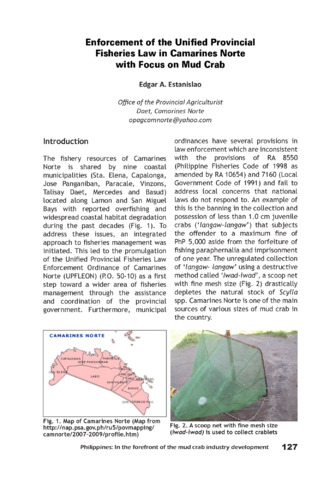
Unified provincial fisheries law enforcement of ordinance of Camarines Norte focusing on mud crab
(Aquaculture Department, Southeast Asian Fisheries Development Center, 2017)Due to overfishing and widespread coastal habitat degradation, the Province of Camarines Norte passed a provincial fisheries law enforcement known as the Unified Provincial Fisheries Law Enforcement Ordinance of Camarines ... -
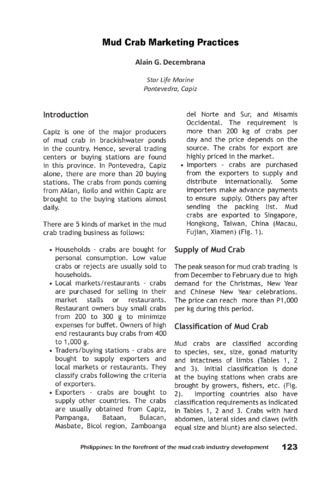
Mud crab marketing practices
(Aquaculture Department, Southeast Asian Fisheries Development Center, 2017)Presented in the article is the mud crab (Scylla spp.) marketing practices in the province of Capiz. It is one of the major producers of mud crab in brackishwater ponds in the country. Hence, several trading centers or ... -
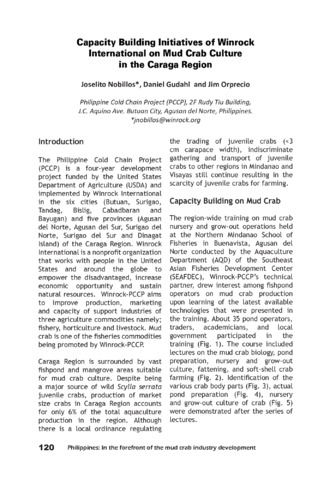
Capacity building initiatives of Winrock International on mud crab culture in the Caraga Region
(Aquaculture Department, Southeast Asian Fisheries Development Center, 2017)The paper presents the output of the capacity building initiatives of Winrock International on Mud crab culture in the Caraga Region, Philippines. The capacity building seminar included lectures on the mud crab biology, ... -
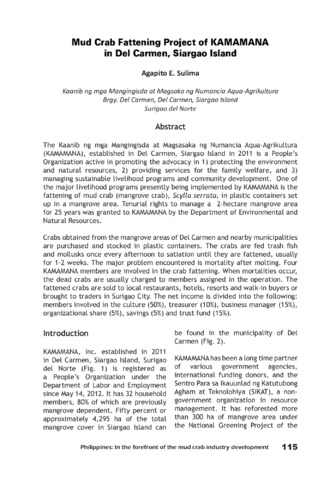
Mud crab fattening project of KAMAMANA in Del Carmen, Siargao Island
(Aquaculture Department, Southeast Asian Fisheries Development Center, 2017)The Kaanib ng mga Mangingisda at Magsasaka ng Numancia Aqua-Agrikultura (KAMAMANA), established in Del Carmen, Siargao Island in 2011 is a People's Organization active in promoting the advocacy in 1) protecting the environment ... -
Polyculture of mud crab in Region 3
(Aquaculture Department, Southeast Asian Fisheries Development Center, 2017)The polyculture of mud crab with one to three other species (milkfish (Chanos chanos), tilapia (Oreochromis spp.) and shrimp or sugpo (Penaeus monodon)) is a common practice in Region 3. Pond preparation is given importance ... -
Trading of juvenile crabs and grow-out culture in Capiz
(Aquaculture Department, Southeast Asian Fisheries Development Center, 2017)The article presents the trade of juvenile crabs in the Province of Capiz, Philippines. Moreover grow-out culture was also presented. Likewise, common problems encountered in the trade, and culture of the crabs was discussed. -
Mangroves as mud crab habitats
(Aquaculture Department, Southeast Asian Fisheries Development Center, 2017)The paper reports the use of mangroves by Scylla species both as wild and culture habitats. Based on published literature, natural mangrove crab populations are described in terms of population density, dispersal and ... -
Mangrove structure and mud crab population in northern Samar
(Aquaculture Department, Southeast Asian Fisheries Development Center, 2017)This study assessed the mangrove community structure, relative seasonal abundance of all size classes of crabs (catch per unit effort or CPUE) and percent composition of the catch in two collection grounds in Pambujan and ... -
Diseases affecting wild and farmed mud crab in the Philippines
(Aquaculture Department, Southeast Asian Fisheries Development Center, 2017)Mortalities due to cannibalism and diseases have been reported as major problems in the grow-out phase of mud crab production. This study aimed to identify and describe diseases affecting farmed and wild mud crab (mangrove ... -
Overview of the mud crab industry in the Philippines
(Aquaculture Department, Southeast Asian Fisheries Development Center, 2017)Mud crab farming has long been established in the Philippines and the country is the second top producer in the world. Except for Scylla paramamosain, the three other species, S. serrata, S. tranquebarica and S. olivacea ... -
Addressing acute hepatopancreatic necrosis disease (AHPND) and other transboundary diseases for improved aquatic animal health in Southeast Asia: Proceedings of the ASEAN Regional Technical Consultation on EMS/AHPND and Other Transboundary Diseases for Improved Aquatic Animal Health in Southeast Asia, 22-24 February 2016, Makati City, Philippines
(Aquaculture Department, Southeast Asian Fisheries Development Center, 2016) -
Important diseases and practical control measures in shrimp culture in Japan
(Aquaculture Department, Southeast Asian Fisheries Development Center, 2016)The gross product from sea culture in Japan was about USD 3.4 billion in 2013 with kuruma shrimp Marsupenaeus japonicus constituting 2% of the total production. In recent years, annual shrimp production has reached about ...