SEAFDEC/AQD Conference Proceedings: Recent submissions
Now showing items 181-200 of 339
-
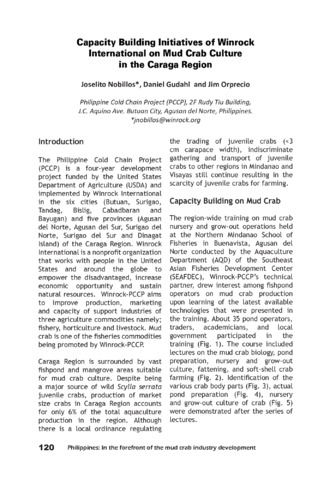
Capacity building initiatives of Winrock International on mud crab culture in the Caraga Region
(Aquaculture Department, Southeast Asian Fisheries Development Center, 2017)The paper presents the output of the capacity building initiatives of Winrock International on Mud crab culture in the Caraga Region, Philippines. The capacity building seminar included lectures on the mud crab biology, ... -
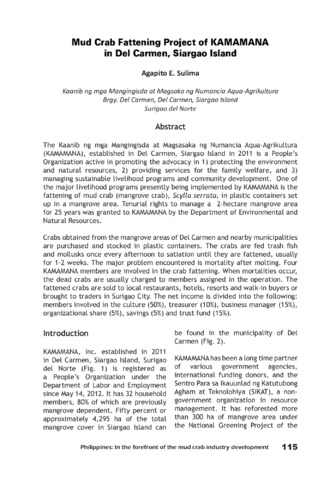
Mud crab fattening project of KAMAMANA in Del Carmen, Siargao Island
(Aquaculture Department, Southeast Asian Fisheries Development Center, 2017)The Kaanib ng mga Mangingisda at Magsasaka ng Numancia Aqua-Agrikultura (KAMAMANA), established in Del Carmen, Siargao Island in 2011 is a People's Organization active in promoting the advocacy in 1) protecting the environment ... -
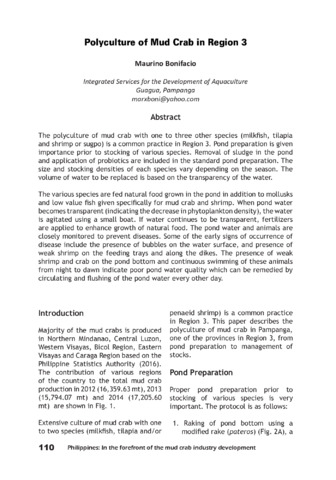
Polyculture of mud crab in Region 3
(Aquaculture Department, Southeast Asian Fisheries Development Center, 2017)The polyculture of mud crab with one to three other species (milkfish (Chanos chanos), tilapia (Oreochromis spp.) and shrimp or sugpo (Penaeus monodon)) is a common practice in Region 3. Pond preparation is given importance ... -
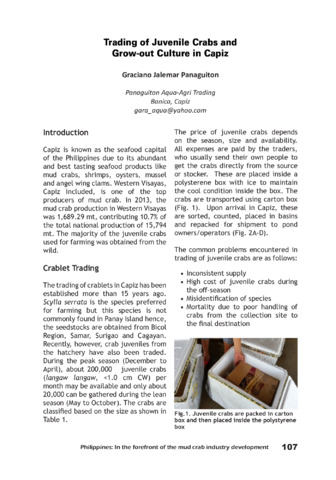
Trading of juvenile crabs and grow-out culture in Capiz
(Aquaculture Department, Southeast Asian Fisheries Development Center, 2017)The article presents the trade of juvenile crabs in the Province of Capiz, Philippines. Moreover grow-out culture was also presented. Likewise, common problems encountered in the trade, and culture of the crabs was discussed. -
Mangroves as mud crab habitats
(Aquaculture Department, Southeast Asian Fisheries Development Center, 2017)The paper reports the use of mangroves by Scylla species both as wild and culture habitats. Based on published literature, natural mangrove crab populations are described in terms of population density, dispersal and ... -
Mangrove structure and mud crab population in northern Samar
(Aquaculture Department, Southeast Asian Fisheries Development Center, 2017)This study assessed the mangrove community structure, relative seasonal abundance of all size classes of crabs (catch per unit effort or CPUE) and percent composition of the catch in two collection grounds in Pambujan and ... -
Diseases affecting wild and farmed mud crab in the Philippines
(Aquaculture Department, Southeast Asian Fisheries Development Center, 2017)Mortalities due to cannibalism and diseases have been reported as major problems in the grow-out phase of mud crab production. This study aimed to identify and describe diseases affecting farmed and wild mud crab (mangrove ... -
Overview of the mud crab industry in the Philippines
(Aquaculture Department, Southeast Asian Fisheries Development Center, 2017)Mud crab farming has long been established in the Philippines and the country is the second top producer in the world. Except for Scylla paramamosain, the three other species, S. serrata, S. tranquebarica and S. olivacea ... -
Addressing acute hepatopancreatic necrosis disease (AHPND) and other transboundary diseases for improved aquatic animal health in Southeast Asia: Proceedings of the ASEAN Regional Technical Consultation on EMS/AHPND and Other Transboundary Diseases for Improved Aquatic Animal Health in Southeast Asia, 22-24 February 2016, Makati City, Philippines
(Aquaculture Department, Southeast Asian Fisheries Development Center, 2016) -
Important diseases and practical control measures in shrimp culture in Japan
(Aquaculture Department, Southeast Asian Fisheries Development Center, 2016)The gross product from sea culture in Japan was about USD 3.4 billion in 2013 with kuruma shrimp Marsupenaeus japonicus constituting 2% of the total production. In recent years, annual shrimp production has reached about ... -
Status of acute hepatopancreatic necrosis disease (AHPND) of cultured shrimps in the Philippines
(Aquaculture Department, Southeast Asian Fisheries Development Center, 2016)Shrimp is the fourth most important aquaculture commodity in the Philippines in terms of production quantity and second in terms of export value. The two species of shrimp being cultivated in the Philippines are the black ... -
Regional response on AHPND and other emerging shrimp diseases in the Asia-Pacific
(Aquaculture Department, Southeast Asian Fisheries Development Center, 2016)Transboundary aquatic animal diseases are among the major concerns for establishing biosecurity measures and strengthening of aquatic animal health (AAH) management capacity (including emergency preparedness) in the region. ... -
Status of shrimp health management in Myanmar
(Aquaculture Department, Southeast Asian Fisheries Development Center, 2016)Extensive cultivation of the black tiger shrimp (Penaeus monodon) started in the 1970 s in Myanmar using trap and hold method. P. monodon postlarvae (PL) were trapped into the ponds measuring approximately 50 to 100 hectares ... -
OIE initiatives on acute hepatopancreatic necrosis disease (AHPND) and other aquatic animal diseases in Asia
(Aquaculture Department, Southeast Asian Fisheries Development Center, 2016)The World Organization for Animal Health (OIE) is an intergovernmental organization established in 1924 responsible for improving animal health and welfare worldwide to facilitate safe international trade of animals and ... -
Latest research on acute hepatopancreatic necrosis disease (AHPND) of penaeid shrimps
(Aquaculture Department, Southeast Asian Fisheries Development Center, 2016)Acute hepatopancreatic necrosis disease (AHPND) is caused by unique strains of Vibrio parahaemolyticus (VPAHPND) and V. harveyi that have transferrable plasmid carrying the virulent PirAB-like toxin genes. The ... -
Current status and impact of early mortality syndrome (EMS)/acute hepatopancreatic necrosis disease (AHPND) and hepatopancreatic microsporidiosis (HPM) outbreaks on Thailand s shrimp farming
(Aquaculture Department, Southeast Asian Fisheries Development Center, 2016)Outbreak of early mortality syndrome (EMS) or acute hepatopancreatic necrosis disease (AHPND) in whiteleg shrimp (Penaeus vannamei) and black tiger shrimp (P. monodon) was first documented in August 2011 in Eastern Thailand. ... -
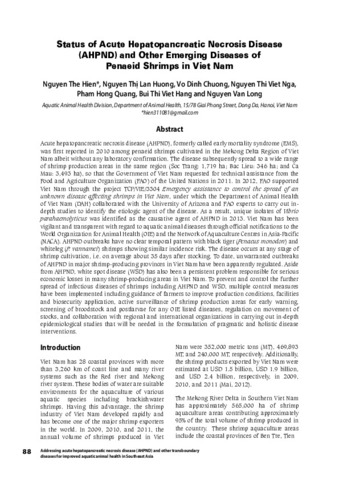
Status of acute hepatopancreatic necrosis disease (AHPND) and other emerging diseases of penaeid shrimps in Viet Nam
(Aquaculture Department, Southeast Asian Fisheries Development Center, 2016)Acute hepatopancreatic necrosis disease (AHPND), formerly called early mortality syndrome (EMS), was first reported in 2010 among penaeid shrimps cultivated in the Mekong Delta Region of Viet Nam albeit without any laboratory ... -
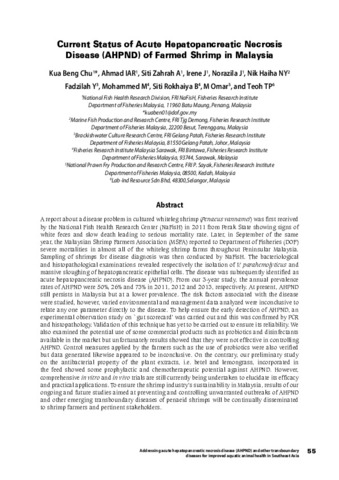
Current status of acute hepatopancreatic necrosis disease (AHPND) of farmed shrimp in Malaysia
(Aquaculture Department, Southeast Asian Fisheries Development Center, 2016)A report about a disease problem in cultured whiteleg shrimp (Penaeus vannamei) was first received by the National Fish Health Research Center (NaFisH) in 2011 from Perak State showing signs of white feces and slow death ... -
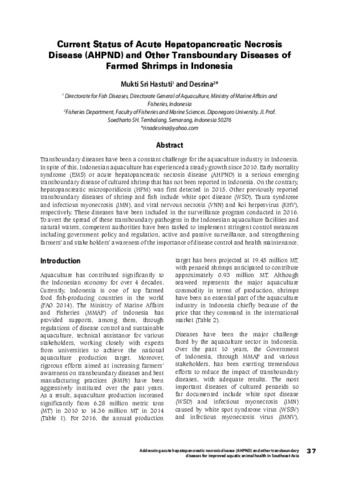
Current status of acute hepatopancreatic necrosis disease (AHPND) and other transboundary diseases of farmed shrimps in Indonesia
(Aquaculture Department, Southeast Asian Fisheries Development Center, 2016)Transboundary diseases have been a constant challenge for the aquaculture industry in Indonesia. In spite of this, Indonesian aquaculture has experienced a steady growth since 2010. Early mortality syndrome (EMS) or acute ... -
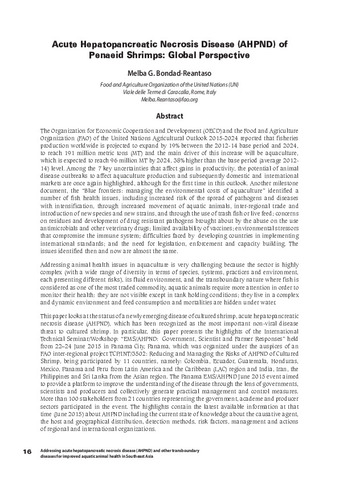
Acute hepatopancreatic necrosis disease (AHPND) of penaeid shrimps: Global perspective
(Aquaculture Department, Southeast Asian Fisheries Development Center, 2016)The Organization for Economic Cooperation and Development (OECD) and the Food and Agriculture Organization (FAO) of the United Nations Agricultural Outlook 2015-2024 reported that fisheries production worldwide is projected ...