SEAFDEC/AQD Conference Proceedings: Recent submissions
Ipinapakita ngayon ang mga item 141-160 ng 339
-
Status of mud crab industry in India
(Rajiv Gandhi Centre for Aquaculture (MPEDA), 2015)Mud crab is an economically important portunid crab species found in estuaries, coastal lagoons and nearshore waters of India. The genetics team of RGCA recently made an attempt to decipher the taxonomic ambiguity of mud ... -
Status of mud crab industry in the Philippines
(Rajiv Gandhi Centre for Aquaculture (MPEDA), 2015)Mud crab farming has long been established in the Philippines. Scylla serrata, S. tranquebarica and S. olivacea are the common species found in the Philippines. S. serrata is the preferred species for farming by crab ... -
Fisheries, cultivation and research aspects of mud crab (Genus Scylla) in China
(Rajiv Gandhi Centre for Aquaculture (MPEDA), 2015)Mud crabs are distributed only along the coastal areas of southeast China. Of the four Scylla species found in China, Scylla paramamosain is the dominant species. The annual wild catch of mud crabs in mainland China was ... -
Status of mud crab aquaculture in Bangladesh
(Rajiv Gandhi Centre for Aquaculture (MPEDA), 2015)Bangladesh has about 710 km of coastlines with 618,780 ha of mangrove tidal flats and 80,000 ha of associated areas which are suitable for brackishwater aquaculture. Mud crab culture has been practiced for many years in ... -
Philippines: In the forefront of the mud crab industry: Proceedings of the 1st National Mud Crab Congress
(Aquaculture Department, Southeast Asian Fisheries Development Center, 2017) -
Biological evaluation of existing feed formulations for the grow-out culture of the mud crab, Scylla serrata
(Aquaculture Department, Southeast Asian Fisheries Development Center, 2017)This study was conducted to identify a formulated pelleted feed for the grow-out culture of the mud crab. A commercial crab feed (CCF) was evaluated together with fish by-catch (FBC) and three test diets (formulated and ... -
Effect of feed binder on water stability and digestibility of formulated feed for the mud crab Scylla serrata
(Aquaculture Department, Southeast Asian Fisheries Development Center, 2017)The binding capacity of six natural and eight synthetic feed binders were tested in a basal diet formulated for the mud crab. Incorporation levels of natural binders ranged from 1 to 25% while those of synthetic binders ... -
Nursery culture of mud crab Scylla serrata using different feeding rates
(Aquaculture Department, Southeast Asian Fisheries Development Center, 2017)The effect of different feeding rates on the production and profitability of Phases 1 and 2 (3-week each) nursery culture of hatchery-produced crab Scylla serrata was determined. Minced mussel meat and formulated diet (at ... -
Nursery culture of mud crab, Scylla serrata, using different ratios of natural food to formulated feed
(Aquaculture Department, Southeast Asian Fisheries Development Center, 2017)The effect of feeding different ratios of natural food to formulated feed on the production and profitability of Phases 1 and 2 of nursery culture (3 weeks per phase) of hatchery-produced crab Scylla serrata was investigated. ... -
Breeding and culture of the polychaete, Marphysa mossambica, as feed for the mud crab
(Aquaculture Department, Southeast Asian Fisheries Development Center, 2017)Marine worms (Annelida: Polychaeta) are considered as important food for crustacean broodstock because they contain hormones and correct balance of essential nutrients for reproduction. Marphysa mossambica (Peters, 1854) ... -
Implication of mud crab culture technology transfer on rural coastal communities: The case in northern Samar, Philippines
(Aquaculture Department, Southeast Asian Fisheries Development Center, 2017)The socio-economic implications of technology transfer of mud crab culture on small-scale growers in Northern Samar and the mechanism of nursery technology transfer were investigated. The study covered four Peoples ... -
Development of aquasilviculture at BFAR-NBFTC, Pagbilao, Quezon
(Aquaculture Department, Southeast Asian Fisheries Development Center, 2017)Aquasilviculture technology verification project was conducted at the National Brackishwater Fisheries Technology Center (NBFTC) of the Bureau of Fisheries and Aquatic Resources (BFAR) in 1996-2000. Results indicated that ... -
Enhancing mud crab population through mangrove restoration
(Aquaculture Department, Southeast Asian Fisheries Development Center, 2017)Mangroves are known as important nurseries for different species of fish and shellfish. In the Philippines, mud crabs Scylla spp. are among the most valuable crustaceans harvested from the mangroves and are considered a ... -
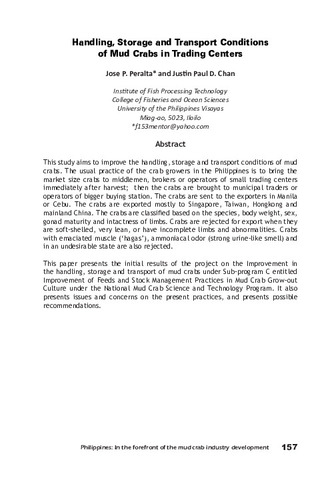
Handling, storage and transport conditions of mud crabs in trading centers
(Aquaculture Department, Southeast Asian Fisheries Development Center, 2017)This study aims to improve the handling, storage and transport conditions of mud crabs. The usual practice of the crab growers in the Philippines is to bring the market size crabs to middlemen, brokers or operators of small ... -
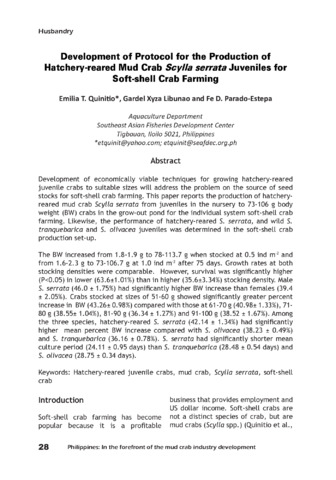
Development of protocol for the production of hatchery-reared mud crab Scylla serrata juveniles for soft-shell crab farming
(Aquaculture Department, Southeast Asian Fisheries Development Center, 2017)Development of economically viable techniques for growing hatchery-reared juvenile crabs to suitable sizes will address the problem on the source of seed stocks for soft-shell crab farming. This paper reports the production ... -
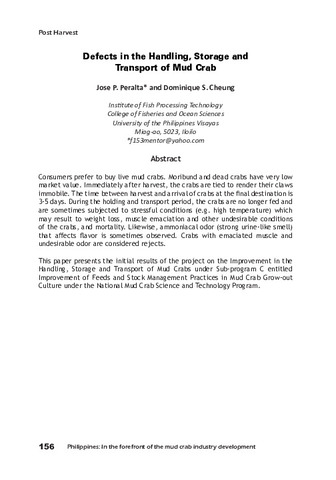
Defects in the handling, storage and transport of mud crab
(Aquaculture Department, Southeast Asian Fisheries Development Center, 2017)Consumers prefer to buy live mud crabs (Scylla). Moribund and dead crabs have very low market value. Immediately after harvest, the crabs are tied to render their claws immobile. The time between harvest and arrival of ... -
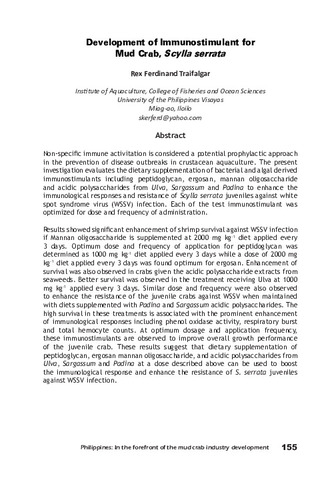
Development of immunostimulant for mud crab, Scylla serrata
(Aquaculture Department, Southeast Asian Fisheries Development Center, 2017)Non-specific immune activitation is considered a potential prophylactic approach in the prevention of disease outbreaks in crustacean aquaculture. The present investigation evaluates the dietary supplementation of bacterial ... -
Strategies to reduce disease incidence in mud crab culture
(Aquaculture Department, Southeast Asian Fisheries Development Center, 2017)Mud crab hatchery suffers from low survival due to susceptibility to bacterial infection in the early larval stages among many causes. Despite food safety issues, antibiotics continue to be used in the absence of effective ... -
Pilot scale production of pellets suitable for mud crab Scylla serrata
(Aquaculture Department, Southeast Asian Fisheries Development Center, 2017)Studies were conducted towards the pilot scale production of stable and nutritionally adequate pellets suitable for mud crab Scylla serrata to help in efforts to increase mud crab production in the Philippines. Preliminary ... -
Nursery and grow-out feeding management of mud crab farmers in the Philippines: Santeh experience
(Aquaculture Department, Southeast Asian Fisheries Development Center, 2017)Mud crab (Scylla serrata) farming has been one of the means of livelihood of many Filipino farmers in coastal areas, specifically in Southern Luzon and Visayas. Nursery and grow-out operations in these areas vary in terms ...