The country report of the Republic of Vietnam: Fishers resources of Vietnam
Share
abstrak
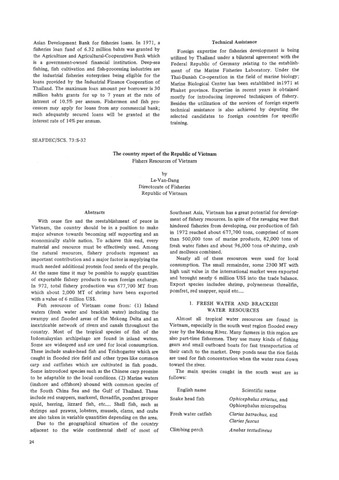
With cease fire and the reestablishment of peace in Vietnam, the country should be in a position to make major advance towards becoming self supporting and an economically stable nation. To achieve this end, every material and resource must be effectively used. Among the natural resources, fishery products represent an important contribution and a major factor in supplying the much needed additional protein food needs of the people. At the same time it may be possible to supply quantities of exportable fishery products to earn foreign exchange. In 972, total fishery production was 677,700 MT from which about 2,000 MT of shrimp have been exported with a value of 6 million US$.
Fish resources of Vietnam come from: (1) Inland waters (fresh water and brackish water) including the swampy and flooded areas of the Mekong Delta and an inextricable network of rivers and canals throughout the country. Most of the tropical species of fish of the Indomalaysian archipelago are found in inland waters. Some are widespread and are used for local consumption. These include snake-head fish and Trichogaster which are caught in flooded rice field and other types like common carp and catfishes which are cultivated in fish ponds. Some introduced species such as the Chinese carp promise to be adaptable to the local conditions. (2) Marine waters (inshore and offshore) abound with common species of the South China Sea and the Gulf of Thailand. These include red snappers, mackerel, threadfin, pomfret grouper squid, herring, lizard fish, etc… Shell fish, such as shrimps and prawns, lobsters, mussels, clams, and crabs are also taken in variable quantities depending on the area.
Due to the geographical situation of the country adjacent to the wide continental shelf of most of Southeast Asia, Vietnam has a great potential for development of fishery resources. In spite of the ravaging war that hindered fisheries from developing, our production of fish in 1972 reached about 677,700 tons, comprised of more than 500,000 tons of marine products, 82,000 tons of fresh water fishes and about 96,000 tons of shrimp, crab and molluscs combined.
Nearly all of these resources were used for local consumption. The small remainder, some 2300 MT with high unit value in the international market were exported and brought nearly 6 million US$ into the trade balance. Export species included shrimp, polynemeus threadfin, pomfret, red snapper, squid etc…
Suggested Citation
Le Van Dang. (1977). The country report of the Republic of Vietnam: Fishers resources of Vietnam. In Proceedings of the Technical Seminar on South China Sea Fisheries Resources, Bangkok, Thailand, 21-25 May 1973 (pp. 24–26). Tokyo, Japan: Japan International Cooperation Agency.
Subjek

Related items
Showing items related by title, author, creator and subject.
-
Report of the regional study on sea cucumber fisheries, utilization, and trade in Southeast Asia, 2007-2008
(Secretariat, Southeast Asian Fisheries Development Center, 2009)The present trend towards overfishing of sea cucumbers in diverse geographical areas to supply international market demand has become an urgent concern in the international community. There is also an attempt to conserve ... -
Proceedings of the Regional Seminar on Integrated Coastal Resources Management in Southeast Asia: Lessons Learned through Integrated Coastal Resources Management in Pathew District, Chumphon Province (ICRM-PD)
(Training Department, Southeast Asian Fisheries Development Center, 2007-09)The proceedings contain the papers that were presented at a regional seminar on integrated coastal resources management. The seminar was conducted to 1) report the achievement and outcome of the project during its 5-year ... -
Strategies for sustainable use of living aquatic resources
(Aquaculture Department, Southeast Asian Fisheries Development Center, 1994)