Establishment of Marine Refugia in Malaysia: Conservation and Protection of Wild Penaeid Shrimp Stock in Baram, Sarawak and Wild Lobster Population in Tanjung Leman, Johor

Share
抄録
The Department of Fisheries Malaysia (DOFM) has taken initial steps in ensuring that natural resources are not threatened with extinction by introducing the concept of special refugia for two commodities, such as the penaeid shrimp and lobster. Tanjung Leman in Johor (Southeast of Peninsula Malaysia) has been identified as special refugia for lobster, and Kuala Baram (Northeast of Sarawak State) as special refugia for the penaeid shrimp. Since 2006, annual landings of lobster (Panulirus spp.) in Johor had been dramatically decreasing below 500 metric tons (MT) from previously recorded which was 2059 MT in 2002. Landings of lobster had dropped particularly in the West Coast of Peninsula Malaysia while landings in the East Coast, such as in Sabah and Sarawak also showed decreasing trend to below 200 MT. For penaeid shrimp (Penaeus monodon), capture data mainly from Sabah and Sarawak also showed decreasing pattern from 1948 MT in 2003 to 1226 MT in 2013. The month of March is the highest peak for annual landings of lobster and penaeid shrimp in Malaysia, mostly delivered by trawlers. Harvest of lobster and penaeid shrimp had contributed around 89% and 74%, respectively, to the overall catch landings of the country. Currently, several committees and action groups involving various stakeholders in the two areas were established and plans of action for 2014-2018 serve as written guidelines and references for all stakeholders. The successful implementation of the concept of refugia for seasonal conservation of a freshwater fish in Sabah under the program called Tagal System, had been an inspiration of the concerned stakeholders, believing that such success could be replicated in other areas of the country and for other economically-important aquatic species.
Suggested Citation
Manap, M. G. bin A. (2016). Establishment of marine refugia in Malaysia: Conservation and protection of wild Penaeid shrimp stock in Baram, Sarawak and wild lobster population in Tanjung Leman, Johor. In H. Kawamura, T. Iwata, Y. Theparoonrat, N. Manajit, & V. T. Sulit (Eds.), Consolidating the Strategies for Fishery Resources Enhancement in Southeast Asia. Proceedings of the Symposium on Strategy for Fisheries Resources Enhancement in the Southeast Asian Region, Pattaya, Thailand, 27-30 July 2015 (pp. 59-63). Samutprakan, Thailand: Training Department, Southeast Asian Fisheries Development Center.
主題

Related items
Showing items related by title, author, creator and subject.
-
Marine environment: Conservation and utilization
(Aquaculture Department, Southeast Asian Fisheries Development Center, 1989) -
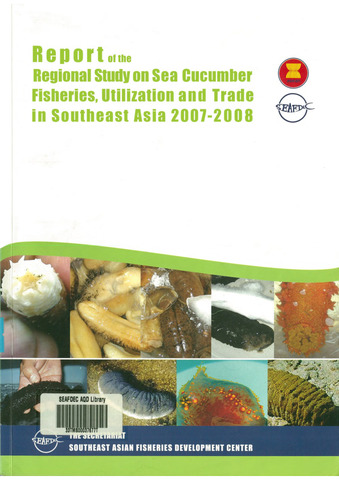
Report of the regional study on sea cucumber fisheries, utilization, and trade in Southeast Asia, 2007-2008
(Secretariat, Southeast Asian Fisheries Development Center, 2009)The present trend towards overfishing of sea cucumbers in diverse geographical areas to supply international market demand has become an urgent concern in the international community. There is also an attempt to conserve ... -
Proceedings of the Regional Seminar on Integrated Coastal Resources Management in Southeast Asia: Lessons Learned through Integrated Coastal Resources Management in Pathew District, Chumphon Province (ICRM-PD)
(Training Department, Southeast Asian Fisheries Development Center, 2007-09)The proceedings contain the papers that were presented at a regional seminar on integrated coastal resources management. The seminar was conducted to 1) report the achievement and outcome of the project during its 5-year ...