Current status of shrimp farming and diseases in Cambodia
Share
抄録
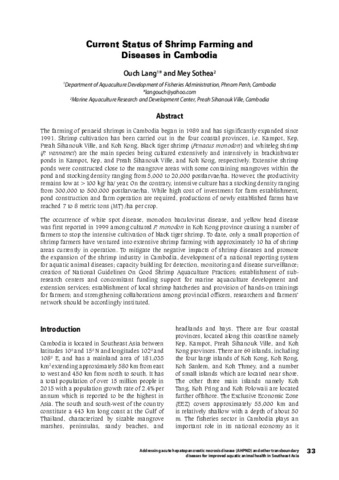
The farming of penaeid shrimps in Cambodia began in 1989 and has significantly expanded since 1991. Shrimp cultivation has been carried out in the four coastal provinces, i.e. Kampot, Kep, Preah Sihanouk Ville, and Koh Kong. Black tiger shrimp (Penaeus monodon) and whiteleg shrimp (P. vannamei) are the main species being cultured extensively and intensively in brackishwater ponds in Kampot, Kep, and Preah Sihanouk Ville, and Koh Kong, respectively. Extensive shrimp ponds were constructed close to the mangrove areas with some containing mangroves within the pond and stocking density ranging from 5,000 to 20,000 postlarvae/ha. However, the productivity remains low at >100 kg/ ha/ year. On the contrary, intensive culture has a stocking density ranging from 300,000 to 500,000 postlarvae/ha. While high cost of investment for farm establishment, pond construction and farm operation are required, productions of newly established farms have reached 7 to 8 metric tons (MT) /ha per crop.
The occurrence of white spot disease, monodon baculovirus disease, and yellow head disease was first reported in 1999 among cultured P. monodon in Koh Kong province causing a number of farmers to stop the intensive cultivation of black tiger shrimp. To date, only a small proportion of shrimp farmers have ventured into extensive shrimp farming with approximately 10 ha of shrimp areas currently in operation. To mitigate the negative impacts of shrimp diseases and promote the expansion of the shrimp industry in Cambodia, development of a national reporting system for aquatic animal diseases; capacity building for detection, monitoring and disease surveillance; creation of National Guidelines On Good Shrimp Aquaculture Practices; establishment of subresearch centers and concomitant funding support for marine aquaculture development and extension services; establishment of local shrimp hatcheries and provision of hands-on trainings for farmers; and strengthening collaborations among provincial officers, researchers and farmers network should be accordingly instituted.
Suggested Citation
Lang, O., & Sothea, M. (2016). Current status of shrimp farming and diseases in Cambodia. In R. V. Pakingking Jr., E. G. T. de Jesus-Ayson, & B. O. Acosta (Eds.), Addressing Acute Hepatopancreatic Necrosis Disease (AHPND) and Other Transboundary Diseases for Improved Aquatic Animal Health in Southeast Asia: Proceedings of the ASEAN Regional Technical Consultation on EMS/AHPND and Other Transboundary Diseases for Improved Aquatic Animal Health in Southeast Asia, 22-24 February 2016, Makati City, Philippines (pp. 33-36). Tigbauan, Iloilo, Philippines: Aquaculture Department, Southeast Asian Fisheries Development Center.
主題
aquaculture economics  ; aquaculture techniques ; bacterial diseases ; disease transmission ; environmental impact ; fish diseases ; husbandry diseases ; pond culture ; shrimp culture ; trade ; vibriosis ; viral diseases ; Penaeidae; Penaeus monodon; Penaeus vannamei; Vibrio harveyi; Vibrio parahaemolyticus; Cambodia
; aquaculture techniques ; bacterial diseases ; disease transmission ; environmental impact ; fish diseases ; husbandry diseases ; pond culture ; shrimp culture ; trade ; vibriosis ; viral diseases ; Penaeidae; Penaeus monodon; Penaeus vannamei; Vibrio harveyi; Vibrio parahaemolyticus; Cambodia
Taxonomic term

Related items
Showing items related by title, author, creator and subject.
-
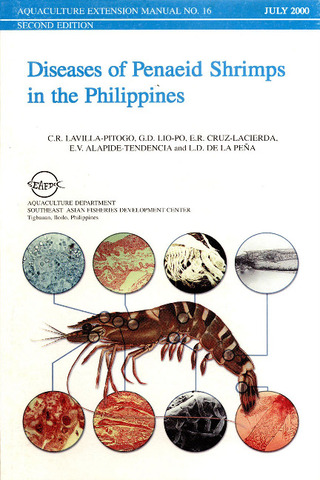
Diseases of penaeid shrimps in the Philippines
(Aquaculture Department, Southeast Asian Fisheries Development Center, 2000)The manual provides information on the diseases that affect the 3 major species of shrimps cultured in the Philippines: Penaeus monodon, P. merguiensis and P. indicus. It includes the common name of the disease, causative ... -
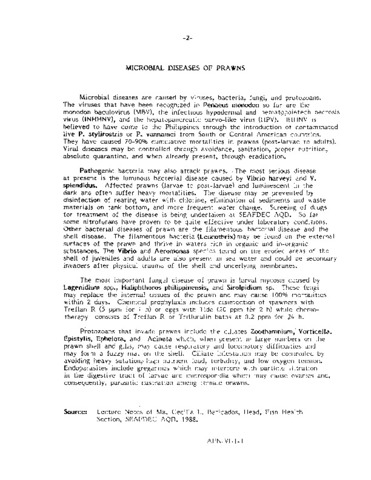
Microbial diseases of prawns
(Aquaculture Department, Southeast Asian Fisheries Development Center, 1988) -
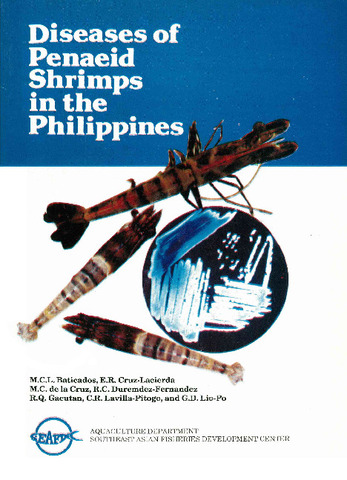
Diseases of penaeid shrimps in the Philippines
(Aquaculture Department, Southeast Asian Fisheries Development Center, 1990)The manual provides information on the diseases that affect the 3 major species of shrimps culture in the Philippines: Penaeus monodon, P. merguiensis and P. indicus. It includes the common name of the disease, causative ...