Seaweed resources in the developing countries of Asia: Production and socio-economic implications
Share
抄録
The bulk of world seaweed production today comes from developed countries in the temperate region, including Japan, China, and Korea. The seaweed production potentials in the developing countries of Asia will have to be explored to meet the increasing world demand. Extensive shallow and farmable reef areas as well as cheap labor highly favor seaweed production. Harvesting from natural stocks is unreliable; efforts should thus be directed toward actual farming of seaweeds. In the Philippines, development of the farming technology on Eucheuma alvarezii and E. denticulatum significantly increased production by the middle of the 70 s. Harvests of Eucheuma from farms and other seaweeds from natural stocks now rank third among the fishery exports of the country. The socioeconomic implications of the development of the seaweed resources in the developing countries of Asia are discussed. The Philippine experience is cited specifically to show the benefits derived from seaweed farming technology.
Suggested Citation
Trono Jr., G. C. (1990). Seaweed resources in the developing countries of Asia: Production and socio-economic implications. In I. J. Dogma Jr., G. C. Trono Jr., & R. A. Tabbada (Eds.), Culture and use of algae in Southeast Asia: Proceedings of the Symposium on Culture and Utilization of Algae in Southeast Asia, 8-11 December 1981, Tigbauan, Iloilo, Philippines. (pp. 1-7). Tigbauan, Iloilo, Philippines: Aquaculture Department, Southeast Asian Fisheries Development Center.
主題

Collections
Related items
Showing items related by title, author, creator and subject.
-
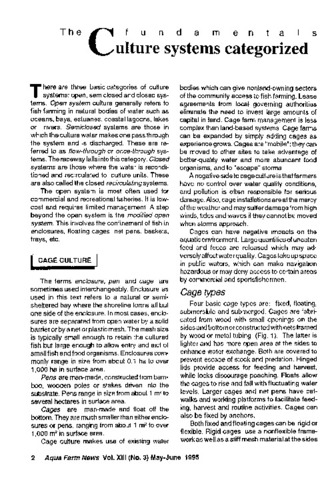
Culture systems categorized: The fundamentals
(Aquaculture Department, Southeast Asian Fisheries Development Center, 1995)The article presents the three basic categories of culture systems: open, semiclosed and closed systems. Open system culture generally refers to fish farming in natural bodies of water such as oceans, bays, estuaries, ... -
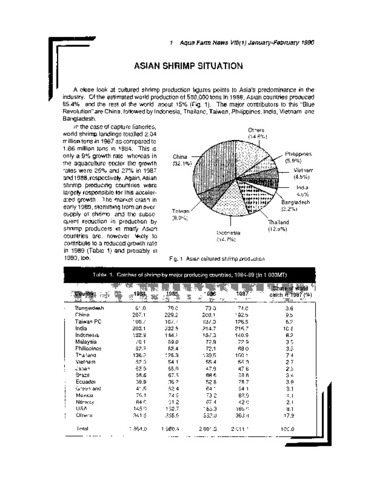
Asian shrimp situation
(Aquaculture Department, Southeast Asian Fisheries Development Center, 1990) -
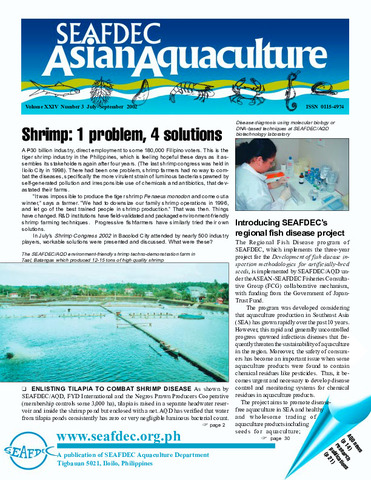
Shrimp: 1 problem, 4 solutions
(Aquaculture Department, Southeast Asian Fisheries Development Center, 2002)