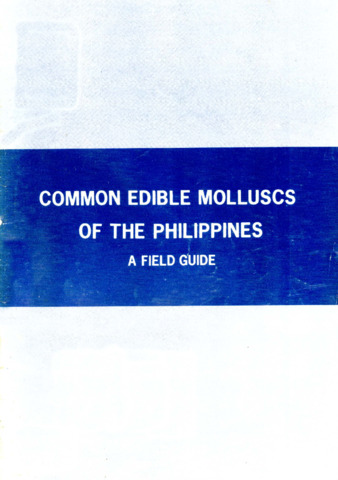
Common edible molluscs of the Philippines: A field guide
Share
Paglalarawan
The Molluscs comprise the largest phylum of marine invertebrates, with over 80,000 species described (Barnes, 1974). They are soft-bodied animals, which, in most cases, secrete a protective outer "shell." Two major classes of molluscs, the Bivalvia and Gastropoda (or univalves), are covered in this work, as they contain most of the edible and economically important species. Class Cephalopoda is represented by the Chambered Nautilus.
Because of the huge number of molluscan species inhabiting Philippine waters (over 20,000 by some estimates) this study has been limited to the most common edible ones existing on and around the island of Panay in the Western Visayas region. This region was selected as representative because some species unique to the Philippine co-exist here with many that are commonly found throughout the Indo-Pacific (Abbott, 1979) and because Panay is located in the geographic center of the Philippines. The species described here are primarily marine, with a few brackish and fresh water varieties included. Marine species predominate in local diets, partly as a result of the increased use of chemical pesticides and fertilizers in recent years in ricelands and fishponds, which were once prime habitats for many edible fresh and brackish water species.
As our world becomes more polluted and populous, edible molluscs, which serve as a major source of protein for many millions of people (Abbott, 1976), are becoming a primary focus of those involved in mariculture activities. This field guide is intended not only for them, but also for students, shell collectors, travelers, and anyone interested in molluscs and how they benefit the people of the Philippines.
This work consists of a series of identification sheets which contain the following basic information:
1. Pen and ink drawings and photographs of each species
2. Scientific classification
3. Common names in English and Philippine dialects
4. Brief description of shell color and form
5. Ecological and habitat description
6. Collection and/or culture techniques
7. Market price
8. Preparation as food
Supplementary or unusual information about each species is also included where appropriate.
Paksa
marine molluscs  ; shells ; oysters ; aquatic molluscs ; scallops ; clams ; mussels ; cockles ; snails ; Batan
  ; Aklan ; Western Visayas ; Panay
; shells ; oysters ; aquatic molluscs ; scallops ; clams ; mussels ; cockles ; snails ; Batan ; Aklan ; Western Visayas ; Panay
Taxonomic term
Anadara granosa  ; Tegillarca granosa ; Arca antiquata ; Anadara antiquata ; Anadara ; Modiolus metcalfei ; Modiolus modulaides ; Perna viridis ; Brachidontes ; Amusium pleuronectes ; Crassostrea iredalei ; Magallana bilineata ; Saccostrea ; Placuna placenta ; Cardium subrugosum ; Vasticardium subrugosum ; Soletellina ; Isognomon ; Mactra mera ; Mactra grandis ; Mactra maculata ; Pharella acutidens ; Donax ; Geloina ; Paphia exarata ; Circe ; Teredo ; Trochus niloticus ; Rochia nilotica ; Turbo chrysostomus ; Angaria delphinus ; Cypraea moneta ; Monetaria moneta ; Cypraea tigris ; Telescopium telescopium ; Potamides ; Lambis lambis ; Strombus aurisdianae ; Euprotomus aurisdianae ; Strombus bulla ; Euprotomus bulla ; Strombus lentiginosus ; Lentigo lentiginosus ; Strombus luhuanus ; Conomurex luhuanus ; Strombus ; Turritella terebra ; Conus leopardus ; Conus omaria ; Conus striatus ; Conus ; Ocenebra ; Oliva annulata ; Cymbiola vespertilio ; Nautilus pompilius ; Pectinidae ; Arcidae
; Tegillarca granosa ; Arca antiquata ; Anadara antiquata ; Anadara ; Modiolus metcalfei ; Modiolus modulaides ; Perna viridis ; Brachidontes ; Amusium pleuronectes ; Crassostrea iredalei ; Magallana bilineata ; Saccostrea ; Placuna placenta ; Cardium subrugosum ; Vasticardium subrugosum ; Soletellina ; Isognomon ; Mactra mera ; Mactra grandis ; Mactra maculata ; Pharella acutidens ; Donax ; Geloina ; Paphia exarata ; Circe ; Teredo ; Trochus niloticus ; Rochia nilotica ; Turbo chrysostomus ; Angaria delphinus ; Cypraea moneta ; Monetaria moneta ; Cypraea tigris ; Telescopium telescopium ; Potamides ; Lambis lambis ; Strombus aurisdianae ; Euprotomus aurisdianae ; Strombus bulla ; Euprotomus bulla ; Strombus lentiginosus ; Lentigo lentiginosus ; Strombus luhuanus ; Conomurex luhuanus ; Strombus ; Turritella terebra ; Conus leopardus ; Conus omaria ; Conus striatus ; Conus ; Ocenebra ; Oliva annulata ; Cymbiola vespertilio ; Nautilus pompilius ; Pectinidae ; Arcidae
Mga koleksyon
- AQD Handbooks [6]
Related items
Showing items related by title, author, creator and subject.
-
Coastal aquaculture in Thailand
(Aquaculture Department, Southeast Asian Fisheries Development Center, 1995)Coastal aquaculture in Thailand has expanded rapidly in both area and production in the last decade. The important cultured species are the shrimps (Penaeus monodon and P. merguiensis), sea bass Lates calcarifer, groupers ... -
Aquaculture in Malaysia
(Aquaculture Department, Southeast Asian Fisheries Development Center, 1995)Aquaculture in Malaysia is experiencing rapid growth. Total production in 1992 amounted to 79,699 tons valued at RM 207.4 million. These figures are 23% and 25% higher than the previous year's. Semi-culture of the cockle ... -
Developments in mollusc farming in Southeast Asia
(Aquaculture Department, Southeast Asian Fisheries Development Center, 2001)Southeast Asia has a relatively long tradition in mollusc culture. The mollusc species of commercial significance in this region are the blood cockles (Anadara granosa), the green mussels (Perna viridis), the oysters ...