Ipakita ang simpleng tala ng item
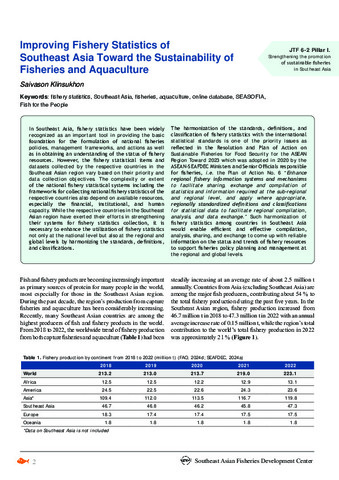
Improving Fishery Statistics of Southeast Asia Toward the Sustainability of Fisheries and Aquaculture
Share
| dc.contributor.author | Klinsukhon, Saivason | |
| dc.date.accessioned | 2025-01-23T02:05:53Z | |
| dc.date.available | 2025-01-23T02:05:53Z | |
| dc.date.issued | 2024-12 | |
| dc.identifier.uri | http://hdl.handle.net/20.500.12066/7579 | |
| dc.description.abstract | In Southeast Asia, fishery statistics have been widely recognized as an important tool in providing the basic foundation for the formulation of national fisheries policies, management frameworks, and actions as well as in obtaining an understanding of the status of fishery resources. However, the fishery statistical items and datasets collected by the respective countries in the Southeast Asian region vary based on their priority and data collection objectives. The complexity or extent of the national fishery statistical systems including the frameworks for collecting national fishery statistics of the respective countries also depend on available resources, especially the financial, institutional, and human capacity. While the respective countries in the Southeast Asian region have exerted their efforts in strengthening their systems for fishery statistics collection, it is necessary to enhance the utilization of fishery statistics not only at the national level but also at the regional and global levels by harmonizing the standards, definitions, and classifications. The harmonization of the standards, definitions, and classification of fishery statistics with the international statistical standards is one of the priority issues as reflected in the Resolution and Plan of Action on Sustainable Fisheries for Food Security for the ASEAN Region Toward 2023 which was adopted in 2020 by the ASEAN-SEAFDEC Ministers and Senior Officials responsible for fisheries, i.e. the Plan of Action No. 6 “Enhance regional fishery information systems and mechanisms to facilitate sharing, exchange and compilation of statistics and information required at the sub-regional and regional level, and apply where appropriate, regionally standardized definitions and classifications for statistical data to facilitate regional compilation, analysis, and data exchange.” Such harmonization of fishery statistics among countries in Southeast Asia would enable efficient and effective compilation, analysis, sharing, and exchange to come up with reliable information on the status and trends of fishery resources to support fisheries policy planning and management at the regional and global levels. | en |
| dc.language.iso | en | en |
| dc.publisher | Secretariat, Southeast Asian Fisheries Development Center | en |
| dc.title | Improving Fishery Statistics of Southeast Asia Toward the Sustainability of Fisheries and Aquaculture | en |
| dc.type | magazineArticle | en |
| dc.citation.volume | 22 | |
| dc.citation.issue | 3 | |
| dc.citation.spage | 2 | en |
| dc.citation.epage | 9 | en |
| dc.citation.journalTitle | Fish for the People | en |
| local.subject | fishery statistics | en |
| local.subject | Southeast Asia | en |
| local.subject | fisheries | en |
| local.subject | aquaculture | en |
| local.subject | online database | en |
| local.subject | SEASOFIA | en |
| local.subject | Fish for the People | en |
Mga file sa item na ito
Lumilitaw ang item na ito sa sumusunod na (mga) Koleksyon
Related items
Showing items related by title, author, creator and subject.
-
Inland fishes of Myanmar
(Secretariat, Southeast Asian Fisheries Development Center, 2005-12)This handbook of some inland fishes in Myanmar was based on a rapid field survey of SEAFDEC supported team and long term observation of the authors on common species and some taxa, obtained from the aquarium trade. We ...