အရာများအတွက် ရိုးရှင်းသော မှတ်တမ်းများကို ပြပါ။
Converting Marine Plastic Debris into Useful Fuel: a case study of nylon netting fragments and discarded plastic bags in Rayong, Thailand
Share
| dc.contributor.author | Manomayidthikarn, Khunthawat | |
| dc.contributor.author | Arnupapboon, Sukchai | |
| dc.date.accessioned | 2025-12-12T07:56:19Z | |
| dc.date.available | 2025-12-12T07:56:19Z | |
| dc.date.issued | 2025-12 | |
| dc.identifier.uri | http://hdl.handle.net/20.500.12066/7637 | |
| dc.description.abstract | Marine plastic pollution, particularly from fishing activities and coastal communities, poses a growing environmental challenge, with Southeast Asia being a significant contributor. The SEAFDEC Training Department, under the project “Sustainable Utilization of Fisheries Resources and Resources Enhancement in Southeast Asia” supported by the Japanese Trust Fund 6-2, conducted a study to address this issue by exploring a thermal pyrolysis-based solution to convert marine plastic debris, specifically nylon netting fragments from crab bottom gillnets and discarded plastic bags, into usable fuel. A survey of local fishers in ten fishing communities along the coast of Rayong, Thailand in 2023 indicated that each community generated significant amounts of nylon netting fragments from crab bottom gillnets, guided the design of a 5-liter reactor capable of processing 1–3 kg of waste. The pyrolysis process, conducted at temperatures between 400 °C and 550 °C, demonstrated that discarded plastic bags yielded a higher oil recovery rate (47.3 %) compared to nylon netting fragments (20.0 %), highlighting the influence of material composition on oil yield. Furthermore, discarded plastic bags were found to be more suitable for pyrolysis due to their quicker ignition and milder odor. While the distillation energy requirements for both types of marine plastic debris were similar, the study identified challenges with nylon netting fragments, including lower oil yield and difficulty with ignition, which may necessitate further technological development to enable effective conversion, such as zeolite catalyst pyrolysis. The study suggests that converting marine plastic debris into useful fuel could provide a sustainable waste-management solution and add value to it for small-scale fishing communities. However, further optimization of the process is required to maximize efficiency and mitigate environmental impacts. | en |
| dc.language.iso | en | en |
| dc.publisher | Secretariat, Southeast Asian Fisheries Development Center | en |
| dc.title | Converting Marine Plastic Debris into Useful Fuel: a case study of nylon netting fragments and discarded plastic bags in Rayong, Thailand | en |
| dc.type | magazineArticle | en |
| dc.citation.volume | 23 | en |
| dc.citation.issue | 2 | en |
| dc.citation.spage | 26 | en |
| dc.citation.epage | 33 | en |
| dc.citation.journalTitle | Fish for the People | en |
| local.subject | marine plastic debris | en |
| local.subject | thermal pyrolysis | en |
| local.subject | marine plastic waste | en |
| local.subject | fuel recovery from plastic waste | en |
| local.subject | sustainable marine waste management | en |
| local.subject | plastic waste elimination | en |
| local.subject | small-scale fisheries | en |
ဤအရာအတွက် ဖိုင်

ဤအရာသည် အောက်ပါစုစည်းမှုများမှ သက်ဆိုင်ပါသည်။
Related items
Showing items related by title, author, creator and subject.
-
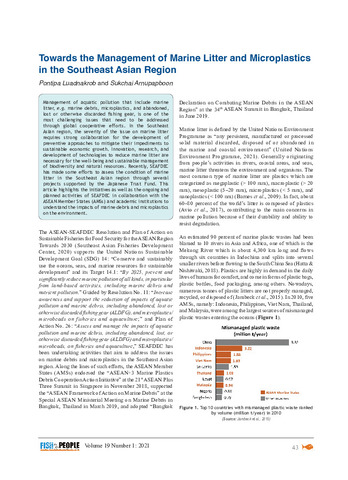
Towards the management of marine litter and microplastics in the Southeast Asian Region
(Secretariat, Southeast Asian Fisheries Development Center, 2021-01-30)Management of aquatic pollution that include marine litter, e.g. marine debris, microplastics, and abandoned, lost or otherwise discarded fishing gear, is one of the most challenging issues that need to be addressed through ... -
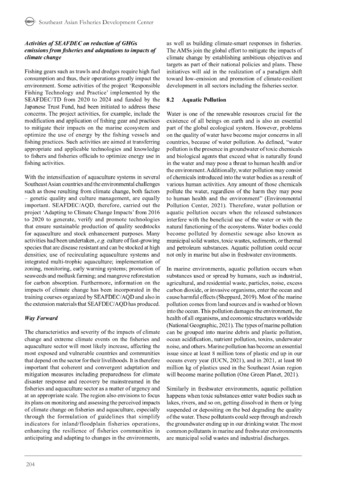
Issues and challenges in sustainable development of fisheries and aquaculture of the Southeast Asian Region: Fisheries-related issues: Aquatic pollution
(Secretariat, Southeast Asian Fisheries Development Center, 2022) -
Ghostfishing Problems and Prevention
(Training Department, Southeast Asian Fisheries Development Center, 1997)Ghostfishing is the fishing activity of lost or abandoned fishing gears or theirarts. This invisible fishing activity of unknown number of fishing gears may have contributed the global depletion of fisheries resources. ...