
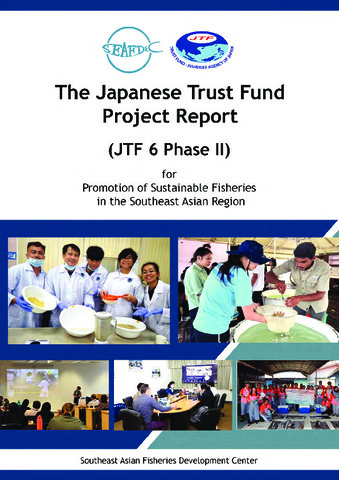
The Japanese Trust Fund Project Report (JTF 6 Phase II)
Share
ບົດຄັດຫຍໍ້
Since 1998, the Government of Japan, through the Japan Trust Fund (JTF), has been a steadfast partner in advancing SEAFDEC’s mission to promote sustainable fisheries and aquaculture in the ASEAN region. Over the past two and a half decades, this partnership has grown stronger, enabling the implementation of numerous regional initiatives that have significantly contributed to policy development, capacity building, and the promotion of responsible fisheries practices across Southeast Asia.
Established by the Fisheries Agency of Japan, the JTF has provided continuous support to SEAFDEC through a series of multi-year project cycles. Each cycle has been carefully designed to respond to the region’s evolving priorities – ranging from foundational capacity building and technology transfers in earlier years, to more recent efforts focused on ecosystem approaches, digital transformation, and adaptive resource management. This progressive and flexible structure has allowed SEAFDEC and its Member Countries to effectively address both persistent and emerging fisheries-related challenges.
This report presents the achievements and outcomes of the most recent implementation cycle – Phase II of the JTF Project 6 (2020–2024). Despite the global disruptions brought about by the COVID-19 pandemic, the activities implemented during this period remained resilient and responsive. Collaborative efforts addressed critical areas such as coastal and inland fisheries management, aquatic animal health, sustainable utilization and conservation of fishery resources and habitats, fishery statistics improvement, climate resilience, combating Illegal, Unreported, and Unregulated (IUU) fishing, and emerging international fisheries-related issues. These initiatives not only supported national and regional policy directions but also contributed to global efforts in promoting sustainable fisheries.
Over the years, the JTF-supported programs have had a transformative impact on the region by strengthening institutional capacities, fostering science-based fisheries and aquaculture practices, and promoting effective responses to climate change, stock depletion, and IUU fishing. They have also supported stock enhancement through restocking programs, habitat rehabilitation, and community-based fisheries resource management initiatives. In addition, these efforts have helped institutionalize sustainable fisheries frameworks aligned with international commitments, improved data systems and fishery statistics, and deepened cooperation among ASEAN Member States. Collectively, these outcomes have positioned SEAFDEC as a leading regional institution in addressing both global and regional fisheries challenges.
Importantly, the work under JTF-6 Phase II has been aligned with broader regional and international frameworks, including the SEAFDEC Resolution and Plan of Action on Sustainable Fisheries for Food Security for the ASEAN Region Towards 2030 (RES&POA-2030), the United Nations Sustainable Development Goals (SDGs)—particularly SDG 14 on Life Below Water—as well as the targets of the Convention on Biological Diversity (CBD). Through these alignments, SEAFDEC and its partners have reinforced efforts to ensure the sustainable use of aquatic resources, the protection of biodiversity, and the enhancement of food security and livelihoods in the region.
On behalf of SEAFDEC, I wish to express our deepest appreciation to the Government of Japan for its continued commitment and generous support to the fisheries sector of Southeast Asia. The trust placed in SEAFDEC and its Member Countries has enabled the region to pursue long-term goals and objectives with confidence and to implement solutions that are locally relevant and regionally coordinated.
Looking ahead, the recently launched JTF Project Phase 7 (2025–2029) builds upon a strong foundation laid over 25 years. It is expected to further promote regional cooperation, strengthen innovation, and address emerging priorities such as climate resilience, digital transformation, and inclusive governance. Ms. Sampan Panjarat With the unwavering support of the Japanese Government, SEAFDEC remains committed to working closely with ASEAN Member States in fostering sustainable, inclusive, and science-based fisheries and aquaculture development for generations to come.
Suggested Citation
SEAFDEC. 2026. Japanese Trust Fund Project Report (JTF6 Phase II) for Promotion of Sustainable Fisheries in the Southeast Asian Region. Southeast Asian Fisheries Development Center, Bangkok, Thailand. 131 pp.