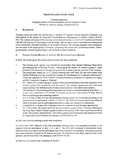
Developing Efficient Strategic Plans for Small-scale Fisheries Co-management: Case Study in Cambodia, Lao PDR, and Thailand
Share
| dc.contributor.author | Tiaye, Rattana | |
| dc.contributor.author | Suasi, Thanyalak | |
| dc.contributor.author | Sopha, Lieng | |
| dc.date.accessioned | 2026-06-19T07:59:57Z | |
| dc.date.available | 2026-06-19T07:59:57Z | |
| dc.date.issued | 2026-06 | |
| dc.identifier.uri | http://hdl.handle.net/20.500.12066/7674 | |
| dc.description.abstract | The case study, which aims to develop efficient strategic plans for small-scale fisheries co-management utilizing SWOT analysis, was conducted under the project “Community Fisheries Co-management: Capacity Building and Sharing Experiences and Lessons Learned among Mekong Region Member Countries” implemented by the Community Fisheries Development Department (CFDD) of the Fisheries Administration (FiA), Ministry of Agriculture, Forestry and Fisheries (MAFF) of Cambodia, with support from the Mekong-Lancang Project. Its main objective is to strengthen the capacity of officers and relevant stakeholders in fisheries co-management for sustainable fisheries resource management by sharing experiences, good practices, and lessons learned among the participating countries, namely: Thailand, Lao PDR, Viet Nam, China, and Cambodia. The Mekong-Lancang Project provided support for the conduct of the case study, which focused on its three participating countries that are also ASEAN Member States (AMSs): Cambodia, Lao PDR, and Thailand. Under the Community Fisheries Co-management Project of CFDD, several capacity-building activities were conducted, such as the Training Workshop on Fisheries Co-management on 11–17 June 2023 in Siem Reap Province, Cambodia; Field Visit to fisheries co-management sites in Lao PDR and Thailand on 25–29 September 2023; and Reflection on the Co-management Situation in Siem Reap Province, Cambodia on 30 November–01 December 2023. The participants in the Training Workshop included representatives from the Mekong-Lancang Participating Countries—Thailand, Lao PDR, Viet Nam, China, and Cambodia, with resource persons from various institutions, including those from Conservation International (CI), Culture and Environment Preservation Association (CEPA), and the Training Department (TD) of the Southeast Asian Fisheries Development Center (SEAFDEC). The fishers’ groups from the study sites in Cambodia, Lao PDR, and Thailand also participated in focus group discussions. Several staff members from SEAFDEC/TD took part in activities to facilitate knowledge- and experience-sharing on fisheries co-management. | en |
| dc.language.iso | en | en |
| dc.publisher | Secretariat, Southeast Asian Fisheries Development Center | en |
| dc.title | Developing Efficient Strategic Plans for Small-scale Fisheries Co-management: Case Study in Cambodia, Lao PDR, and Thailand | en |
| dc.type | Book chapter | en |
| dc.citation.spage | 2 | en |
| dc.citation.epage | 6 | en |
| dc.citation.bookTitle | Fish for the People Vol.24 No.1 | en |
| local.subject | co-management | en |
| local.subject | ecosystem approach to fisheries management | en |
| local.subject | ecological well-being | en |
| local.subject | good governance | en |
| local.subject | human well-being | en |
| local.subject | SWOT analysis | en |
Các tệp trong mục này
Mặt hàng này xuất hiện trong (các) Bộ sưu tập sau
Related items
Showing items related by title, author, creator and subject.
-
Training and Study Tour
(Training Department, Southeast Asian Fisheries Development Center, 2007)Training course and study tour formed part of Activity IV: Enhance Human Resource Capability and Participation of the project on Integrated Coastal Resource Management in Pathew District (ICRM-PD). The subjects and topics ... -
Changes in Fishing Activities After the Coastal Zone Management Project
(Training Department, Southeast Asian Fisheries Development Center, 2007)This paper aims to evaluate the changes in the fishing activities of local fishermen after the implementation of the coastal zone management (CZM) project at Pakklong subdistrict, Pathew District, Chumphon Province by ... -
Resources Enhancement Project Achievement
(Training Department, Southeast Asian Fisheries Development Center, 2007)The paper presents the achievements of the resource enhancement project of the SEAFDEC Training Department in collaboration with the Association of Southeast Asian Nations (ASEAN) and the SEAFDEC member countries. The ...