ສະແດງບັນທຶກທີ່ງ່າຍດາຍສໍາລັບລາຍການ
Stock Assessment and Management of Brushtooth Lizardfish (Saurida undosquamis) in the Gulf of Thailand Using the Menu Driven JABBA Software
Share
| dc.contributor.author | Thitipongtrakul, Weerapol | |
| dc.contributor.author | Pattarapongpan, Supapong | |
| dc.contributor.author | Kulanujaree, Nipa | |
| dc.contributor.author | Prasertsook, Orawan | |
| dc.contributor.author | Nishida, Tom | |
| dc.date.accessioned | 2026-10-06T03:52:27Z | |
| dc.date.available | 2026-10-06T03:52:27Z | |
| dc.date.issued | 2026-10 | |
| dc.identifier.uri | http://hdl.handle.net/20.500.12066/7683 | |
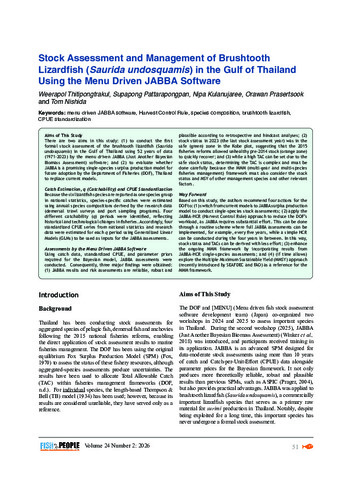
| dc.description.abstract | Aims of This Study There are two aims in this study: (1) to conduct the first formal stock assessment of the brushtooth lizardfish (Saurida undosquamis) in the Gulf of Thailand using 52 years of data (1971–2023) by the menu driven JABBA (Just Another Bayesian Biomass Assessment) software; and (2) to evaluate whether JABBA is a promising single-species surplus production model for future adoption by the Department of Fisheries (DOF), Thailand to replace current models. Catch Estimation, q (Catchability) and CPUE Standardization Because the six lizardfish species are reported as one species group in national statistics, species-specific catches were estimated using annual species compositions derived by the research data (demersal trawl surveys and port sampling programs). Four different catchability (q) periods were identified, reflecting historical and technological changes in fisheries. Accordingly, four standardized CPUE series from national statistics and research data were estimated for each q period using Generalized Linear Models (GLMs) to be used as inputs for the JABBA assessments. Assessments by the Menu Driven JABBA Software Using catch data, standardized CPUE, and parameter priors required for the Bayesian model, JABBA assessments were conducted. Consequently, three major findings were obtained: (1) JABBA results and risk assessments are reliable, robust and plausible according to retrospective and hindcast analyses; (2) stock status in 2023 (the last stock assessment year) was in the safe (green) zone in the Kobe plot, suggesting that the 2015 fisheries reforms allowed unhealthy pre-2014 stock (orange zone) to quickly recover; and (3) while a high TAC can be set due to the safe stock status, determining the TAC is complex and must be done carefully because the MMM (multi-gear and multi-species fisheries management) framework must also consider the stock status and MSY of other management species and other relevant factors. Way Forward Based on this study, the authors recommend four actions for the DOF to: (1) switch from current models to JABBA surplus production model to conduct single-species stock assessments; (2) apply the JABBA-HCR (Harvest Control Rule) approach to reduce the DOF’s workload, as JABBA requires substantial effort. This can be done through a routine scheme where full JABBA assessments can be implemented, for example, every five years, while a simple HCR can be conducted during the four years in between. In this way, stock status and TACs can be derived with less effort; (3) enhance the ongoing MMM framework by incorporating results from JABBA-HCR single-species assessments; and (4) (if time allows) explore the Multiple Maximum Sustainable Yield (MMSY) approach (recently introduced by SEAFDEC and FAO) as a reference for the MMM framework. | en |
| dc.language.iso | en | en |
| dc.publisher | Secretariat, Southeast Asian Fisheries Development Center | en |
| dc.title | Stock Assessment and Management of Brushtooth Lizardfish (Saurida undosquamis) in the Gulf of Thailand Using the Menu Driven JABBA Software | en |
| dc.type | Book chapter | en |
| dc.citation.spage | 51 | en |
| dc.citation.epage | 66 | en |
| dc.citation.bookTitle | Fish for the People Vol.24 No.2 | en |
| local.subject | menu driven JABBA software | en |
| local.subject | Harvest Control Rule | en |
| local.subject | species composition | en |
| local.subject | brushtooth lizardfish | en |
| local.subject | CPUE standardization | en |