Perlihatkan publikasi sederhana
Resilience and Adaptive Responses in Small-scale Coastal Fisheries: Lessons from Ban Khlong Tob, Krabi Province, Thailand
Share
| dc.contributor.author | Tiaye, Rattana | |
| dc.contributor.author | Suasi, Thanyalak | |
| dc.contributor.author | Sornkliang, Jariya | |
| dc.contributor.author | Jaroonpongsawat, Saruttaya | |
| dc.contributor.author | Saraphaivanich, Kongpathai | |
| dc.contributor.author | Chanyim, Anusorn | |
| dc.contributor.author | Kuakakorn, Pornpimol | |
| dc.date.accessioned | 2026-10-06T04:26:02Z | |
| dc.date.available | 2026-10-06T04:26:02Z | |
| dc.date.issued | 2026-10 | |
| dc.identifier.uri | http://hdl.handle.net/20.500.12066/7686 | |
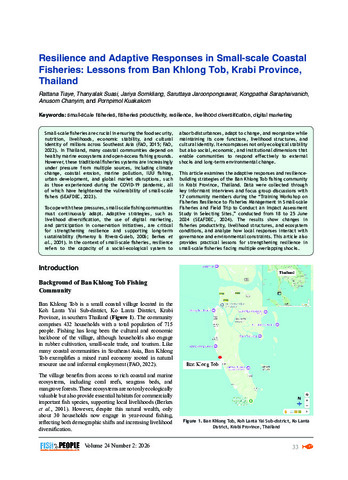
| dc.description.abstract | Small-scale fisheries are crucial in ensuring the food security, nutrition, livelihoods, economic stability, and cultural identity of millions across Southeast Asia (FAO, 2015; FAO, 2022). In Thailand, many coastal communities depend on healthy marine ecosystems and open-access fishing grounds. However, these traditional fisheries systems are increasingly under pressure from multiple sources, including climate change, coastal erosion, marine pollution, IUU fishing, urban development, and global market disruptions, such as those experienced during the COVID-19 pandemic, all of which have heightened the vulnerability of small-scale fishers (SEAFDEC, 2023). To cope with these pressures, small-scale fishing communities must continuously adapt. Adaptive strategies, such as livelihood diversification, the use of digital marketing, and participation in conservation initiatives, are critical for strengthening resilience and supporting long-term sustainability (Pomeroy & Rivera-Guieb, 2006; Berkes et al., 2001). In the context of small-scale fisheries, resilience refers to the capacity of a social-ecological system to absorb disturbances, adapt to change, and reorganize while maintaining its core functions, livelihood structures, and cultural identity. It encompasses not only ecological stability but also social, economic, and institutional dimensions that enable communities to respond effectively to external shocks and long-term environmental change. This article examines the adaptive responses and resilience building strategies of the Ban Khlong Tob fishing community in Krabi Province, Thailand. Data were collected through key informant interviews and focus group discussions with 17 community members during the “Training Workshop on Fisheries Resilience to Fisheries Management in Small-scale Fisheries and Field Trip to Conduct an Impact Assessment Study in Selecting Sites,” conducted from 18 to 25 June 2024 (SEAFDEC, 2024). The results show changes in fisheries productivity, livelihood structures, and ecosystem conditions, and analyze how local responses interact with governance and environmental constraints. This article also provides practical lessons for strengthening resilience in small-scale fisheries facing multiple overlapping shocks. | en |
| dc.language.iso | en | en |
| dc.publisher | Secretariat, Southeast Asian Fisheries Development Center | en |
| dc.title | Resilience and Adaptive Responses in Small-scale Coastal Fisheries: Lessons from Ban Khlong Tob, Krabi Province, Thailand | en |
| dc.type | Book chapter | en |
| dc.citation.spage | 33 | en |
| dc.citation.epage | 37 | en |
| dc.citation.bookTitle | Fish for the People Vol.24 No.2 | en |
| local.subject | small-scale fisheries | en |
| local.subject | fisheries productivity | en |
| local.subject | resilience | en |
| local.subject | livelihood diversification | en |
| local.subject | digital marketing | en |
Files in this item
Publikasi ini ada di koleksi berikut
Related items
Showing items related by title, author, creator and subject.
-
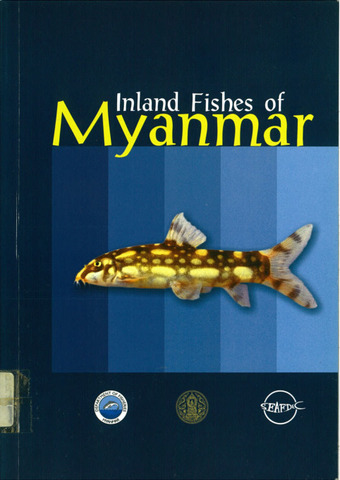
Inland fishes of Myanmar
(Secretariat, Southeast Asian Fisheries Development Center, 2005-12)This handbook of some inland fishes in Myanmar was based on a rapid field survey of SEAFDEC supported team and long term observation of the authors on common species and some taxa, obtained from the aquarium trade. We ...