SEAFDEC Institutional Repository: Recent submissions
3141-3160 / 5920
-
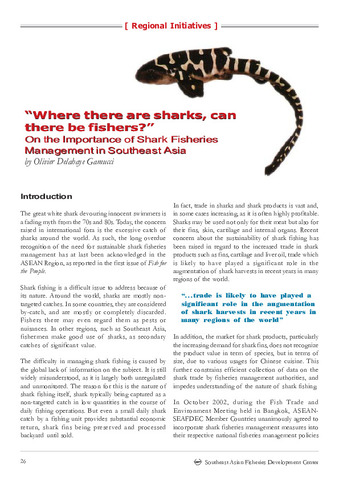
"Where there are sharks, can there be fishers?" On the importance of shark fisheries management in Southeast Asia
(Secretariat, Southeast Asian Fisheries Development Center, 2003)An overview on the importance of shark fisheries management in Southeast Asia is given. In particular recent progress in the region, status and trends of shark fisheries, utilization and trade of shark are given. -
Collection of fisheries data and information: The need for comprehensive national systems
(Secretariat, Southeast Asian Fisheries Development Center, 2003) -
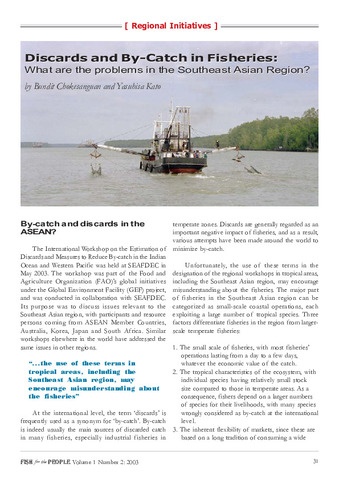
Discards and by-catch in fisheries: What are the problems in the Southeast Asian region?
(Secretariat, Southeast Asian Fisheries Development Center, 2003)This paper summarizes the decisions and the outputs of the International Workshop on the Estimation of Discards and Measures to Reduce By-Catch in the Indian Ocean and Western Pacific held in May 2003 focusing in particular ... -
Digital curation projects: A study of selected academic and research repositories in the Philippines
(Nanyang Technological University, 2016)The paper examines digitization and preservation initiatives in selected academic and research libraries in the Philippines. It identifies the drivers for the projects, practices followed, and issues encountered. Most of ... -
Substrate preference for burying and feeding of sandfish Holothuria scabra juveniles
Altamirano, Jon ; ; (Elsevier, 2017)
Substrate preference for both burying and feeding of sandfish Holothuria scabra juveniles (3–6 g wet body weight) and their associated daily behavior, growth and survival were investigated in laboratory and field experiments ...
; ; (Elsevier, 2017)
Substrate preference for both burying and feeding of sandfish Holothuria scabra juveniles (3–6 g wet body weight) and their associated daily behavior, growth and survival were investigated in laboratory and field experiments ... -
Growth response of cultured larvae of silver therapon Leiopotherapon plumbeus (Kner, 1864) in outdoor tanks in relation to fertilizer type and fish density
(Wiley, 2016)This study evaluated the effects of fertilizer type and fish density on early growth and survival of silver therapon Leiopotherapon plumbeus (Kner, 1864) larvae reared in outdoor tanks. In the first experiment, larvae (1.92 ... -
Temporal changes in innate immunity parameters, epinecidin gene expression, and mortality in orange-spotted grouper, Epinephelus coioides experimentally infected with a fish pathogen, Vibrio harveyi JML1
(Elsevier, 2017)Changes in innate immunity parameters and epinecidin mRNA transcript levels were examined to characterize the non-specific immune response of E. coioides to pathogenic V. harveyi JML1 isolated from affected cage-cultured ... -
Poly-beta-hydroxybutyrate-enriched Artemia sp. for giant tiger prawn Penaeus monodon larviculture
(John Wiley and Sons, 2017)The beneficial effects of PHB as supplement for giant tiger prawn Penaeus monodon postlarvae using a short-term enrichment strategy via Artemia were examined. The effects of co-supplementing with a lipid emulsion were also ... -
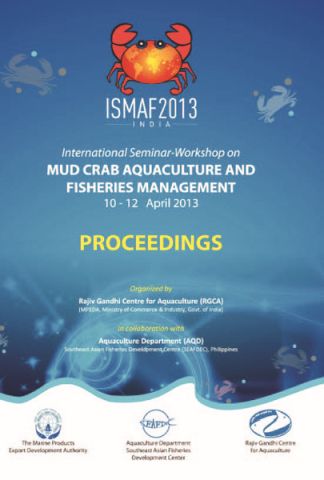
Proceedings of the International Seminar-Workshop on Mud Crab Aquaculture and Fisheries Management, 10-12 April 2013, Tamil Nadu, India
(Rajiv Gandhi Centre for Aquaculture (MPEDA), 2015) -
Development of practical diet for the grow-out culture of Scylla serrata in ponds
(Rajiv Gandhi Centre for Aquaculture (MPEDA), 2015)A series of feeding experiments were conducted in the laboratory and in ponds of SEAFDEC/AQD using hatchery-produced Scylla serrata juveniles to develop an effective pelleted grow-out diet. The practical feed ingredients ... -
Soft-shell crab production using hatchery-produced mangrove crab Scylla serrata juveniles
(Rajiv Gandhi Centre for Aquaculture (MPEDA), 2015)Soft-shell crab production is being practiced in many Asian countries but the major source of seedstock is from the wild, which could no longer sustain the increasing demand. Commercial scale soft-shell crab production can ... -
Culture of Scylla serrata (Forskal) in cement ponds
(Rajiv Gandhi Centre for Aquaculture (MPEDA), 2015)Male and female Scylla serrata juvenile crabs were stocked separately in cement ponds (14 x 8 x 0.8 m; 90 m3) and reared for 90 days. The study was conducted at the Fisheries Research Station, JAU. Okha, Gujarat. The crabs ... -
Mud crab nursery rearing practices
(Rajiv Gandhi Centre for Aquaculture (MPEDA), 2015)The need for seeds for expansion of the mud crab industry led to the development of the hatchery technology. The nursery technology was developed as this served as a link between the hatchery, which produces megalopae or ... -
Effect of tank color on the survival of mud crab Scylla serrata larvae
(Rajiv Gandhi Centre for Aquaculture (MPEDA), 2015)The survival rate of mud crab or mangrove crab Scylla serrata larvae was evaluated using black and yellow-painted tanks. About 400,000 zoea 1 were stocked in 6 tons of treated seawater. The larvae were initially fed with ... -
Mass seed production of mud crab Scylla serrata at Rajiv Gandhi Centre for Aquaculture
(Rajiv Gandhi Centre for Aquaculture (MPEDA), 2015)Mass seed production of mud crab Scylla serrata adopting the best management practices has been done in the hatchery of Rajiv Gandhi Centre for Aquaculture, Thoduvai in Tamil Nadu. Mature female mud crabs from farms and ... -
Reproductive biology of mud crab Scylla tranquebarica found in Ratnagiri coast, Maharashtra, India
(Rajiv Gandhi Centre for Aquaculture (MPEDA), 2015)The study was carried out to determine the reproductive biology of the mud crab Scylla tranquebarica to provide baseline information that are useful in the seed production activities. Size at first maturation was observed ... -
Scylla species found in Cochin backwaters, Kerala, South India
(Rajiv Gandhi Centre for Aquaculture (MPEDA), 2015)The present study described the Scylla species collected from Cochin backwaters for two years from June 2010 to May 2012. Identification and description of Scylla species were carried out based on the morphological characters ... -
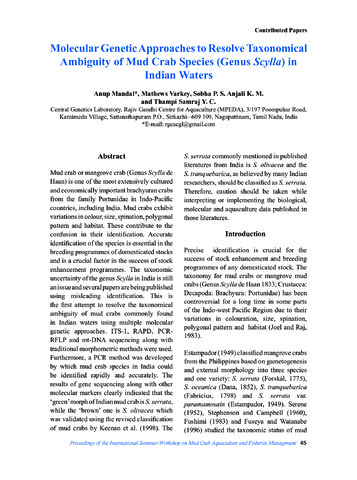
Molecular genetic approaches to resolve taxonomical ambiguity of mud crab species (Genus Scylla) in Indian waters
(Rajiv Gandhi Centre for Aquaculture (MPEDA), 2015)Mud crab or mangrove crab (Genus Scylla de Haan) is one of the most extensively cultured and economically important brachyuran crabs from the family Portunidae in Indo-Pacific countries, including India. Mud crabs exhibit ... -
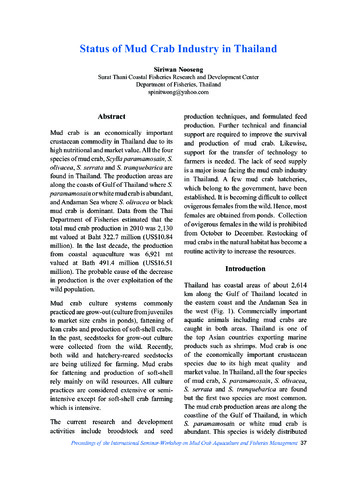
Status of mud crab industry in Thailand
(Rajiv Gandhi Centre for Aquaculture (MPEDA), 2015)Mud crab is an economically important crustacean commodity in Thailand due to its high nutritional and market value. All the four species of mud crab, Scylla paramamosain, S. olivacea, S. serrata and S. tranquebarica are ... -
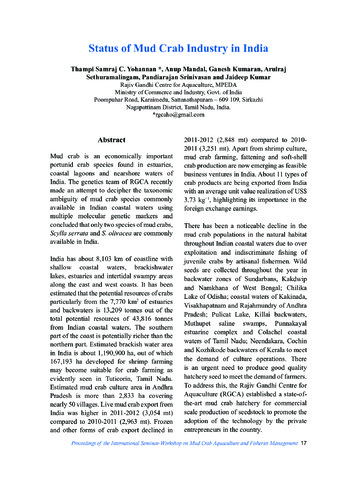
Status of mud crab industry in India
(Rajiv Gandhi Centre for Aquaculture (MPEDA), 2015)Mud crab is an economically important portunid crab species found in estuaries, coastal lagoons and nearshore waters of India. The genetics team of RGCA recently made an attempt to decipher the taxonomic ambiguity of mud ...