SEAFDEC Institutional Repository: Recent submissions
5541-5560 / 5910
-
Cultivation of live feed for the rearing of sugpo (Penaeus monodon) larvae
(European Mariculture Society, 1979)The sugpo, Penaeus monodon, is a very important prawn species in Southeast Asia. It is extremely euryhaline and fast growing. Interest in the farming of this prawn species is very high. Unfortunately, the supply of natural ... -
Engineering and deployment of artificial reefs for a community-based fishery resource management project at Mararison Island, Antique, Philippines
(Japan International Marine Science and Technology Federation, 1995)This paper describes the self-initative of the island's inhabitants in the fabrication and deployment of concrete artificial reefs (ARs) using indigenouse materials as well as appropriate technology at Mararison Island, ... -
Small-scale fisheries and yield of coral reefs in Malalison Island, west central Philippines: Implications for a community-based coastal fishery resource management
(Institute of Fisheries Economics, National Taiwan Ocean University; International Institute of Fisheries Economics and Trade, 1995)Fish landings in Malalison Island on west central Philippines were monitored from February 1991 to January 1992 to determine the fishing gears employed, the predominant species caught, the catch per unit effort (CPUE), and ... -
Voluntary feed intake and energy partitioning in tilapia, (Oreochromis niloticus) fed diets with different protein/energy levels
(Wageningen Pers, 2001)In order to investigate the effect of different protein/energy levels of diets (two commercial and one laboratory) on voluntary feed intake and energy partitioning in tilapia (O. niloticus), 15 fishes with an initial body ... -
The plight of older women in a fishing village: The women fish traders of Bugtong Bato, Aklan, central Philippines
(ICLARM, 2001)The changing nature of the fisheries in Bugtong Bato, a small fishing community in Central Philippines has also changed the role of women, particularly of older women, in the community. Until the 1980s, fishing used mainly ... -
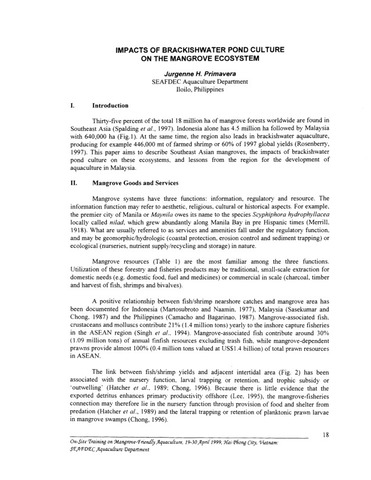
Impacts of brackishwater pond culture on the mangrove ecosystem
(Southeast Asian Fisheries Development Center, Aquaculture Department, 2000)This paper aims to describe Southeast Asian mangroves, the impacts of brackishwater pond culture on these ecosystems, and lessons from the region for the development of aquaculture in Malaysia. -
Aquaculture
(Elsevier, 2001)Aquaculture, the aquatic counterpart of agriculture, has grown rapidly in recent decades to become one of the most important means of obtaining food from the sea. Impacts of aquaculture on biodiversity arise from the ... -
The rabbitfishes
(Elsevier, 1995) -
Recent developments in freshwater and marine cage aquaculture in the Philippines
(Asian Fisheries Society; World Aquaculture Society - Southeast Asian Chapter, 2000)Fish production from freshwater cages and pens, and marine cages and pens constitute 19% of the total foodfish produced from aquaculture in the Philippines. In 1998, production from freshwater cages and pens contributed ... -
Restocking of windowpane shell, Placuna placenta in a depleted bed off Tigbauan, Iloilo, the Philippines
(Phuket Marine Biological Center, 2000)The Tigbauan coast, Iloilo, the Philippines, has been depleted of the natural population of the windowpane shell, Placuna placenta Linnaeus, 1758, since the early 1980's. To support the declining P. placenta industry of ... -
Illuminated-cage nursery of the Asian sea bass, Lates calcarifer Bloch, (Centropomidae): effects of initial body size and stocking density
(Asian Fisheries Society; World Aquaculture Society - Southeast Asian Chapter, 2000)This study was conducted to determine the appropriate initial body size and the corresponding stocking density of sea bass, Lates calcarifer, during nursery rearing in illuminated cages. Hatchery-produced sea bass fry of ... -
Spontaneous spawning, fecundity and spawning periodicity in the donkey's ear abalone Haliotis asinina Linnaeus 1758
(Phuket Marine Biological Center; Phuket Marine Biological Center Special Publication 21(1), 2000)Spontaneous group spawning was monitored in wild-caught (WC) and hatchery-bred (HB) abalone broodstock (Haliotis asinina) held in duplicate tanks at 1:3 (male: female) ratio from June 1997 to January 1999. Abalone ... -
Postlarvae density and photoperiod effects on the settlement and metamorphosis of the donkey's ear abalone, Haliotis asinina Linne, 1758
(Phuket Marine Biological Center, 2000)The effects of photoperiod and density of postlarvae on settlement and metamorphosis of the native abalone, Haliotis asinina were determined in two separate experiments. Abalone larvae were hatched from spontaneously ... -
Conceptual framework for sustainable aquaculture and coastal resources management: Approach to the adoption of mangrove-friendly aquaculture
(Aquaculture Department, Southeast Asian Fisheries Development Center, 2000) -
Hatchery management for the window-pane shell, Placuna placenta Linnaeus, 1758
(Phuket Marine Biological Center, 2000)To relieve pressure on wild stock population, a hatchery technique for the window-pane shell, Placuna placenta Linnaeus has to be developed. A study was conducted to determine the suitable algal diet for P. placenta during ... -
The use of chemicals in aquaculture in the Philippines
(Aquaculture Department, Southeast Asian Fisheries Development Center, 2000)The intensification of aquaculture in the Philippines has made the use of chemicals and biological products inevitable. A recent survey conducted nation wide among shrimp and milkfish culture facilities revealed the use ... -
Aqua-mangrove integrated farming: Shrimp and mud crab culture in coastal and inland tidal flats with existing reforested or natural growth of mangroves
(Aquaculture Department, Southeast Asian Fisheries Development Center, 2000)Throughout the tropics, mangroves are being destroyed at an increasing rate for the development of aquaculture ponds. In the Philippines, for instance, mangroves were about 400,000 to 500,000 ha in 1918 but were reduced ... -
Mud crab culture
(John Wiley and Sons, 2000)Mud crabs are one of the most widely sought crustacean species that inhabit the estuarine areas and tidal rivers and creeks of the Asian and Indo-Pacific regions. Hailed as "food for the gods," the mud crab is recognized ... -
Development of hatchery techniques for the mud crab Scylla serrata (Forskål): Comparison of feeding schemes
(Australian Centre for International Agricultural Research, 1999)Scylla serrata larvae were reared in 3 L plastic containers and fed various amounts of artificial diets (AD) with or without natural food (NF: Brachionus rotundiformis and newly-hatched Artemia). The amounts of AD fed alone ... -
Monosex culture of the mud crab Scylla serrata at three stocking densities with Gracilaria as crab shelter
(Australian Centre for International Agricultural Research, 1999)The effects of three levels of stocking density (0.5, 1.5 or 3.0/m2) and monosex culture (male or female) on the growth, survival and production of Scylla serrata were investigated. Juvenile crabs were stocked in 150 m2 ...