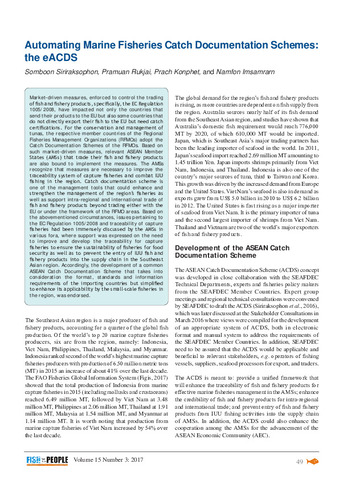
Automating marine fisheries catch documentation schemes: the eACDS
Share
抄録
Market-driven measures, enforced to control the trading of fish and fishery products, specifically, the EC Regulation 1005/2008, have impacted not only the countries that send their products to the EU but also some countries that do not directly export their fish to the EU but need catch certifications. For the conservation and management of tunas, the respective member countries of the Regional Fisheries Management Organizations (RFMOs) adopt the Catch Documentation Schemes of the RFMOs. Based on such market-driven measures, relevant ASEAN Member States (AMSs) that trade their fish and fishery products are also bound to implement the measures. The AMSs recognize that measures are necessary to improve the traceability system of capture fisheries and combat IUU fishing in the region. Catch documentation scheme is one of the management tools that could enhance and strengthen the management of the region’s fisheries as well as support intra-regional and international trade of fish and fishery products beyond trading either with the EU or under the framework of the RFMO areas. Based on the abovementioned circumstances, issues pertaining to the EC Regulation 1005/2008 and traceability of capture fisheries had been immensely discussed by the AMSs in various fora, where support was expressed on the need to improve and develop the traceability for capture fisheries to ensure the sustainability of fisheries for food security as well as to prevent the entry of IUU fish and fishery products into the supply chain in the Southeast Asian region. Accordingly, the development of a common ASEAN Catch Documentation Scheme that takes into consideration the format, standards and information requirements of the importing countries but simplified to enhance its applicability by the small-scale fisheries in the region, was endorsed.
Suggested Citation
Siriraksophon, S., Rukjai, P., Konphet, P., & Imsamrarn, N. (2017). Automating marine fisheries catch documentation schemes: the eACDS. Fish for the People , 15(3), 49-55. http://hdl.handle.net/20.500.12066/1283
主題

Collections
Related items
Showing items related by title, author, creator and subject.
-
The Status of Fisheries in the Republic of Maldives
(Training Department, Southeast Asian Fisheries Development Center, 1997)The paper discusses the tuna fisheries in Maldives which dominates its fishing industry. Apart from a very strong domestic market, tuna is also the main export commodity of the country. Moreover, reef fisheries such as, ... -
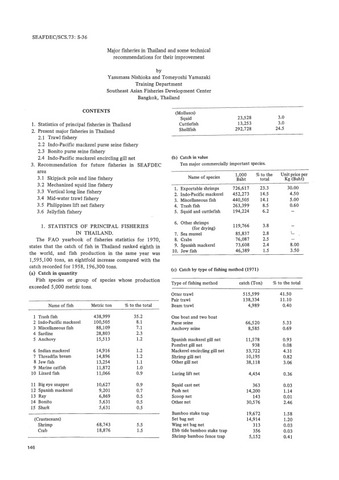
Major fisheries in Thailand and some technical recommendations for their improvement
(Japan International Cooperation Agency, 1977)Presented in this paper is the development of fisheries industry in Thailand. The data on the production of the principal fisheries species and major fishing methods are also presented. Also included are the recommendations ... -
Status of Fishing Conditions in Cambodia
(Training Department, Southeast Asian Fisheries Development Center, 1997)Fisheries in plays a very important role in Cambodia’s national economic development. Total fish catch production in 1996 was 104 310 tones, about which 60% was contributed by inland capture fisheries, 30% by marine capture ...