Survival of larval milkfish, Chanos chanos, during changeover from endogenous to exogenous energy sources
Share
Abstract
Survival of laboratory-reared larvae of milkfish, Chanos chanos , during transition from the prelarval to postlarval stages was examined in relation to the changeover of energy sources. The prelarval and early postlarval stages of the fish can be divided into 5 phases; 1) rapid growth corresponding to rapid yolk less rapid yolk resorption; 3) stagnant growth with rapid yolk resorption, yolk being still the only nutrient for the larvae; 4) stagnant growth based on both yolk and exogenous food, from the onset of feeding to the complete exhaustion of yolk; and 5) rapid growth based solely on exogenous food. The survival rate decreased when the larvae depended solely on yolk, then leveled off when they had both endogenous and exogenous energy sources, and again declined when they came to depend totally on exogenous food. Feeding during the period from the onset of feeding to complete yolk resorption seems important for the successful survival of milk-fish larvae thereafter.
Suggested Citation
Kohno, H., Duray, M., Gallego, A. & Taki, Y. (1990). Survival of larval milkfish, Chanos chanos, during changeover from endogenous to exogenous energy sources. In R. Hirano & I. Hanyu (Eds.), The Second Asian Fisheries Forum: Proceedings of the Second Asian Fisheries Forum, Tokyo, Japan, 17 - 22 April 1989 (pp. 437-440). Manila, Philippines: Asian Fisheries Society.
Paksa

Taxonomic term

Mga koleksyon
Related items
Showing items related by title, author, creator and subject.
-
Small-scale freshwater aquaculture development: Experiences from the Philippines on giant freshwater prawn, milkfish and tilapia
(Japan International Cooperation Agency, 2013-12)The Aquaculture Department of the Southeast Asian Fisheries Development Center (SEAFDEC/AQD) has been promoting a number of programs towards effective dissemination and adoption of science-based aquaculture technologies ... -
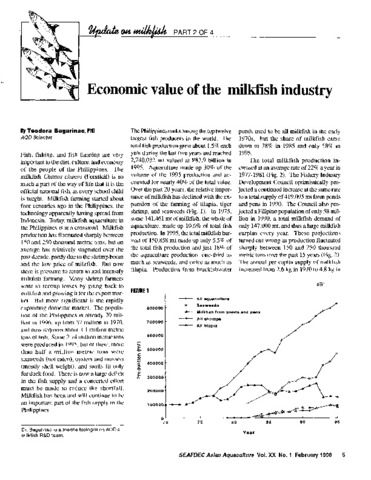
Economic value of the milkfish industry
(Aquaculture Department, Southeast Asian Fisheries Development Center, 1998)A brief description is given of the milkfish (Chanos chanos) farming industry in the Philippines. Over the past 20 years, the relative importance of milkfish has declined with the expansion of tilapia, tiger shrimp and ... -
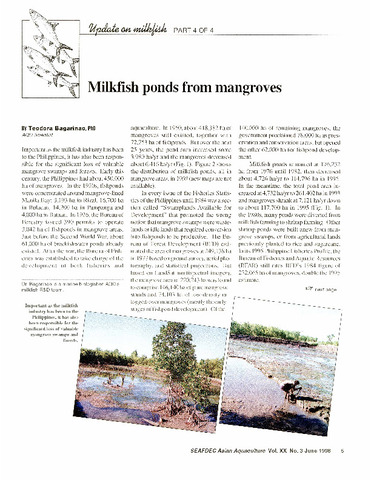
Milkfish ponds from mangroves
(Aquaculture Department, Southeast Asian Fisheries Development Center, 1998)