Management of fish health in broodstock and larvae of milkfish, sea bass and grouper
Share
นามธรรม
Historically, reports on the occurrence of disease problems in milkfish, seabass and grouper were mainly on the isolation and identification of etiological agents. Studies on the tolereance of fish to chemotherapeutants were also conducted. Various species of vibrios and gill-infesting parasites have been associated with diseases in all life stages of these fish. Presently, mortalities due to diseases of unknown etiology, environmental failure and nutritional or husbandry shortfalls affect successful fry production in the hatchery. Morphological deformities in hatchery-produced milkfish fry is a major problem to be solved. In seabass fry production, swim-bladder stress syndrome occasionally occurs and results in mass mortalities. In larval grouper culture, the problem of low survival is being addressed through improved husbandry and nutrition. For cage-held broodstock that naturally spawn in captivity, such as milkfish and grouper, the main problem is fouling of net enclosures in the cages. However, for fish that need hormonal manipulation to spawn, such as seabass and snapper, stressful handling procedures during sampling and hormone injection may lead to injuries and scale loss. The damaged areas become focal points for secondary bacterial infection. Future fish health management strategies in these fish should incorporate a holistic approach to include environmental monitoring, nutritional manipulation, immunostimulants and vaccine use, and biological control in addition to pathogen exclusion in the rearing system and the fish.
การอ้างอิง
Lavilla-Pitogo, C. R., Emata, A. C., Duray, M. N., & Toledo, J. D. (1996). Management of fish health in broodstock and larvae of milkfish, sea bass and grouper. In K. L. Main & C. Rosenfeld (Eds.), Aquaculture health management strategies for marine fishes?: proceedings of a workshop in Honolulu, Hawaii, October 9- 13, 1995 (pp. 47-56). Walmanalo, Hawaii: The Oceanic Institute.
เรื่อง

Taxonomic term

คอลเลกชัน
รายการที่เกี่ยวข้อง
แสดงรายการที่เกี่ยวข้องตามชื่อผู้แต่งผู้สร้างและเรื่อง
-
Small-scale freshwater aquaculture development: Experiences from the Philippines on giant freshwater prawn, milkfish and tilapia
(Japan International Cooperation Agency, 2013-12)The Aquaculture Department of the Southeast Asian Fisheries Development Center (SEAFDEC/AQD) has been promoting a number of programs towards effective dissemination and adoption of science-based aquaculture technologies ... -
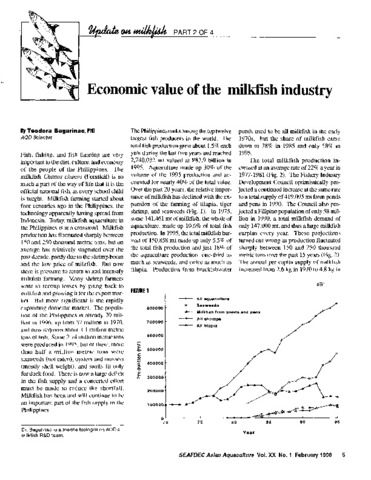
Economic value of the milkfish industry
(Aquaculture Department, Southeast Asian Fisheries Development Center, 1998)A brief description is given of the milkfish (Chanos chanos) farming industry in the Philippines. Over the past 20 years, the relative importance of milkfish has declined with the expansion of tilapia, tiger shrimp and ... -
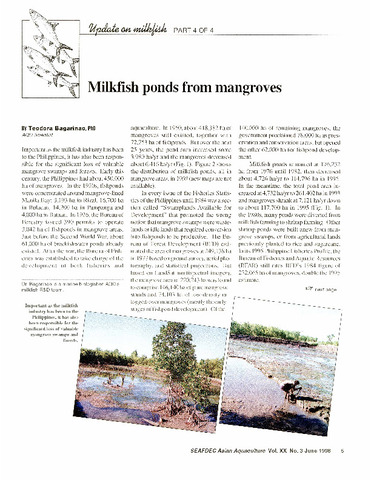
Milkfish ponds from mangroves
(Aquaculture Department, Southeast Asian Fisheries Development Center, 1998)