Egg quality of grouper Epinephelus coioides fed different fatty acid sources
Share
抄録
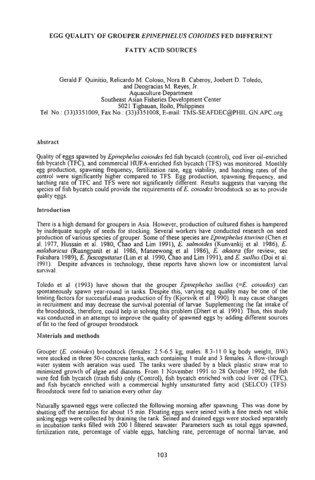
Quality of eggs spawned by Epinephelus coioides fed fish by catch (control). Cod liver oil-enriched fish by catch (TFC), and commercial HUFA A-enriched fish by catch (TFS) was monitored. Monthly egg production, spawning frequency, fertilization rate, egg viability, and hatching rates of the control were significantly higher compared to TFS Egg production. Spawning frequency and hatching rate of TC and TFS were not significantly different. Results suggest that varying the species of fish by catch could provide the requirements of E. Coioides broodstock so as to provide quality eggs.
主題
Collections
Related items
Showing items related by title, author, creator and subject.
-
Development of a giant grouper Luteinizing Hormone (LH) Enzyme-Linked Immunosorbent Assay (ELISA) and its use towards understanding sexual development in grouper
(Elsevier, 2020-07-13)A recombinant giant grouper Luteinizing Hormone (LH) consisting of tethered beta and alpha subunits was produced in a yeast expression system. The giant grouper LH β-subunit was also produced and administered to rabbits ... -
Culture of grouper, sea bass and red snapper
(University of the Philippines Aquaculture Society, Inc., 2001)Marine fish production has increased dramatically in the past ten years and majority of the cultured species were produced in Asia in 1992. Increase in production was accompanied with concerns on increasing outbreak of ... -
Induction of sex inversion in juvenile grouper, Epinephelus malabaricus, (Bloch and Schneider) by bi-weekly injections of 17 alpha-methyltestosterone
(Society for the Study of Endocrinology, Metabolism and Reproduction, University of Hong Kong, 1989)Groupers (Family Serranidae) are protogynous hermaphrodites. Natural sex inversion of different species occurs at 2-11 years of age . The scarcity of wild mature males and the length of time to change sex underline the ...