Larval survival and megalopa production of Scylla sp. at different salinities
Share
抄録
Salinity tolerance was determined for each zoeal stage of Scylla sp. Larvae from ablated pond-grown females were abruptly transferred to salinities of 12, 16, 20, 24, 28 and 32 ppt. Spawning salinity or previous rearing salinity was 32 ppt, except for Z5 which were previously reared at 26 ppt. The mean median lethal time or LT50 values were compared between salinities. For Z1 and Z2, highest values were obtained at 20–32 ppt. Z3 had highest LT50 values at 20–24 ppt and Z4 at 24–32 ppt. For Z5, highest LT50 values were obtained at 20–32 ppt. Another batch of Z3 and Z4 were subjected to the same abrupt salinity transfers and reared to the megalopa stage. Significantly higher percentages of larvae metamorphosed to the megalopa stage at salinities of 20–28 ppt when transfer to test salinities was at Z3. When transfer was at Z4 or Z5, the highest percentage of larvae moulted to the megalopa stage at 24–28 ppt or at 28 ppt, respectively.
Suggested Citation
Parado-Estepa, F. D., & Quinitio, E. T. (1999). Larval survival and megalopa production of Scylla sp. at different salinities. In C. P. Keenan & A. Blackshaw. (Eds.). Mud Crab Aquaculture and Biology. Proceedings of an international scientific forum held in Darwin, Australia, 21–24 April 1997 (pp. 174-177). Canberra, Australia: Australian Centre for International Agricultural Research.
主題
Collections
Related items
Showing items related by title, author, creator and subject.
-
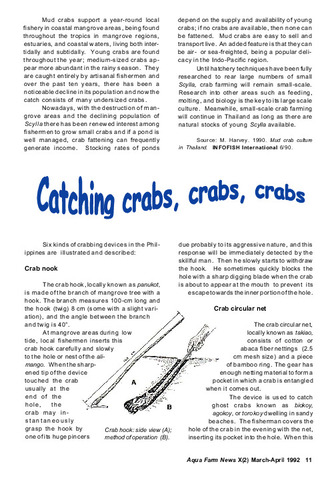
Catching crabs, crabs, crabs
(Aquaculture Department, Southeast Asian Fisheries Development Center, 1992) -
Soft-shell crab production using hatchery-reared mud crab
(Aquaculture Department, Southeast Asian Fisheries Development Center; Philippine Council for Agriculture, Aquatic and Natural Resources Research and Development (PCAARRD), 2015)"The production of soft-shell crabs is well established in other Asian countries but its sustainability is already being threatened due to the decreasing mud crab population in the wild where the seedstocks are sourced. ... -
Monosex culture of the mud crab Scylla serrata at three stocking densities with Gracilaria as crab shelter
(Australian Centre for International Agricultural Research, 1999)The effects of three levels of stocking density (0.5, 1.5 or 3.0/m2) and monosex culture (male or female) on the growth, survival and production of Scylla serrata were investigated. Juvenile crabs were stocked in 150 m2 ...