Economic analysis of an integrated milkfish broodstock and hatchery operation as a public enterprise
Share
Abstract
The National Bangus (Milkfish) Breeding Program of the Philippines, which was launched by the Philippine government in 1981, had succeeded in spawning milkfish in captivity and in rearing the eggs to fry that were stockable in ponds. The physical productivity and economic viability of an integrated milkfish broodstock and hatchery as a public enterprise is analyzed, using SEAFDEC research findings as bases for analysis.
Discounted cash flow computations show the repayment schedule for investments in structures and equipment, and operations and maintenance expenses for both broodstock and hatchery operations covering a period of 15 years. Revenues came from the sales of fry. The analysis was based on an annual stocking of 100 milkfish (200–250 g/piece) per cage with a diameter of 10 m. Egg production started during the fifth year. Investment in the hatchery facilities started during the fourth year and expansion occurred in the subsequent years to accommodate the eggs produced for rearing to the fry stage.
Economic indicators, net present value (NPV) and internal rate of return (IRR), showed negative figures. The trend, however, was upward, starting during the sixth year of operation. Sensitivity analysis was done to determine the effects of changes in operational efficiencies, such as survival rates and stocking densities to the return on investment (ROI) in private hatcheries.
Suggested Citation
Agbayani, R. F., Lopez, N. A., Tumaliuan, R. E., & Berjamin, G. D. (1991). Economic analysis of an integrated milkfish broodstock and hatchery operation as a public enterprise. Aquaculture , 99(3-4), 235-248. https://doi.org/10.1016/0044-8486(91)90244-2
Taxonomic term
Mga koleksyon
- AQD Journal Articles [1249]
Related items
Showing items related by title, author, creator and subject.
-
Small-scale freshwater aquaculture development: Experiences from the Philippines on giant freshwater prawn, milkfish and tilapia
(Japan International Cooperation Agency, 2013-12)The Aquaculture Department of the Southeast Asian Fisheries Development Center (SEAFDEC/AQD) has been promoting a number of programs towards effective dissemination and adoption of science-based aquaculture technologies ... -
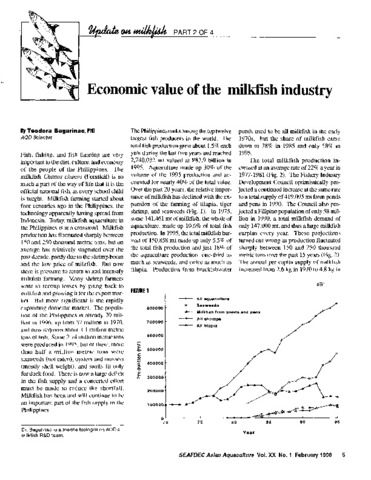
Economic value of the milkfish industry
(Aquaculture Department, Southeast Asian Fisheries Development Center, 1998)A brief description is given of the milkfish (Chanos chanos) farming industry in the Philippines. Over the past 20 years, the relative importance of milkfish has declined with the expansion of tilapia, tiger shrimp and ... -
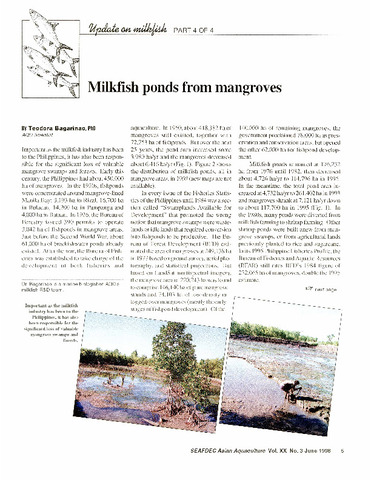
Milkfish ponds from mangroves
(Aquaculture Department, Southeast Asian Fisheries Development Center, 1998)