Egg cannibalism by milkfish (Chanos chanos Forsskal) spawners in circular floating net cages
Quan điểm/
Ngày
1992Page views
435metadata
Hiển thị bản ghi đầy đủ mặt hàngCited times in Scopus
Share
trừu tượng
Egg cannibalism by milkfish spawners in a circular floating net cage was investigated. The cage was lined with a fine mesh hapa net to retain spawned eggs and to prevent the entry of fish egg predators. Water samples were collected from the surface (0 m), middle (1.5 m), and bottom (3.0 m) of a 10 m diameter by 3 m deep floating net cage at the time of initial detection of spawning (0 min) and at 30, 60, 120 and 240 min thereafter. The mean number of spawned eggs at the surface significantly decreased (P<0.05) 60 min after spawning and very few eggs were recovered 240 min later. There was no significant difference (P>0.05) in the mean number of spawned eggs collected from the middle and bottom of the net cage at various times after spawning. Eggs were found in the digestive tract of all milkfish sampled (n=6) at about 5 h after spawning, indicating that captive milkfish eat their own eggs. It is recommended that spontaneously spawned milkfish eggs should be collected immediately after spawning to avoid loss by egg cannibalism.
Suggested Citation
Toledo, J. D., & Gaitan, A. G. (1992). Egg cannibalism by milkfish (Chanos chanos Forsskal) spawners in circular floating net cages. Journal of Applied Ichthyology , 8(1-4), 257-262. https://doi.org/10.1111/j.1439-0426.1992.tb00692.x
Chủ thể
Taxonomic term
Bộ sưu tập
- AQD Journal Articles [1249]
Related items
Showing items related by title, author, creator and subject.
-
Small-scale freshwater aquaculture development: Experiences from the Philippines on giant freshwater prawn, milkfish and tilapia
(Japan International Cooperation Agency, 2013-12)The Aquaculture Department of the Southeast Asian Fisheries Development Center (SEAFDEC/AQD) has been promoting a number of programs towards effective dissemination and adoption of science-based aquaculture technologies ... -
Economic value of the milkfish industry
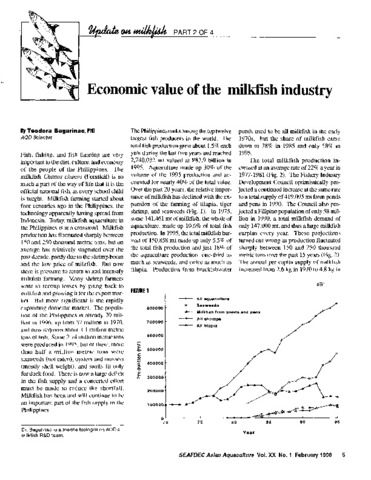
(Aquaculture Department, Southeast Asian Fisheries Development Center, 1998)A brief description is given of the milkfish (Chanos chanos) farming industry in the Philippines. Over the past 20 years, the relative importance of milkfish has declined with the expansion of tilapia, tiger shrimp and ... -
Milkfish ponds from mangroves
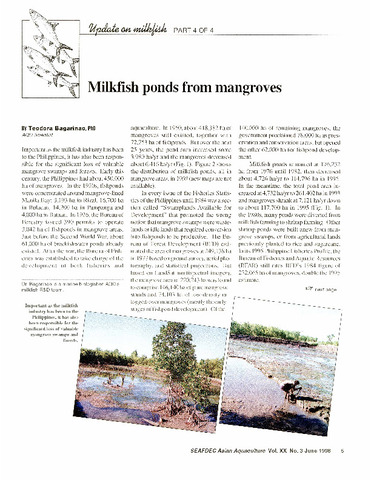
(Aquaculture Department, Southeast Asian Fisheries Development Center, 1998)