Collection of the clam Anodontia edentula in mangrove habitats in Panay and Guimaras, central Philippines
Share
ບົດຄັດຫຍໍ້
The mangrove clam Anodontia edentula is highly prized in the Philippines for its flavor and large size. Because this infaunal species is found down to one meter deep in mangrove areas, harvesting the clam reportedly damages mangrove stands. To evaluate such reports, a survey of collection methods was undertaken in Panay and Guimaras, central Philippines in August 1997-December 1999. Host to chemosynthetic bacterial symbionts that utilize sulfide as energy source, A. edentula are strategically situated in sulfide-rich anoxic substrates but also gain access to oxygenated seawater through a ventilation burrow or tube. By locating the opening of this burrow, collectors can detect the presence of a buried clam and harvest it nondestructively with a blade or bare hands. In contrast, the indiscriminate tilling of wide mangrove areas can damage mangrove plants. Most collectors were 40-45 years old with 22-30 years collection experience, married with 5-7 children, and had low educational attainment. They sold clams directly in the local markets or through middlemen (to restaurants and beach resorts); sales provided from 10% to 100% of daily family income. Collectors complained of decreasing clam sizes and numbers and the physically strenuous work of collecting.
Suggested Citation
Primavera, J., Lebata, M. J. H. L., Gustilo, L. F., & Altamirano, J. (2002). Collection of the clam Anodontia edentula in mangrove habitats in Panay and Guimaras, central Philippines. Wetlands Ecology and Management , 10(5), 363-370. https://doi.org/10.1023/A:1020983218203
ວິຊາ
Taxonomic term
Collections
- AQD Journal Articles [1249]
Related items
Showing items related by title, author, creator and subject.
-
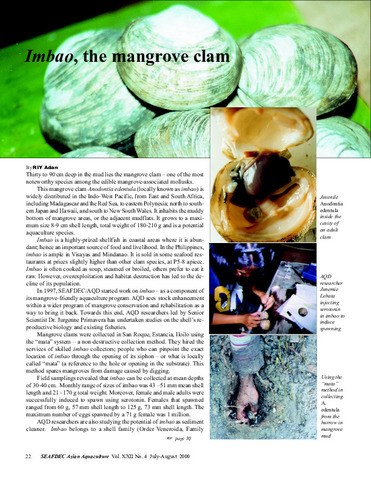
Imbao, the mangrove clam
(Aquaculture Department, Southeast Asian Fisheries Development Center, 2000) -
Molluscan aquaculture in the Philippines: A review
(Springer, 2023-04-25)Molluscs are among the most valuable resources of the Philippines, an archipelagic country of 7,107 islands bounded by 36,000 km of coastline and 26.6 million ha of coastal waters. In 2020, production from mussels and ... -
Oxygen, sulphide and nutrient uptake of the mangrove mud clam Anodontia edentula (Family: Lucinidae)
(Elsevier, 2001)Oxygen, sulphide and nutrient (ammonia, nitrite and phosphate) uptake of Anodontia edentula was measured. Oxygen and sulphide were measured from sealed containers provided with 1 l fresh mangrove mud (sulphide source) and ...