Response of the tropical abalone, Haliotis asinina, larvae on combinations of attachment cues
Share
ບົດຄັດຫຍໍ້
The effects of different diatom species and types of substrates in combination with 0.45 μM GABA on the metamorphosis of Haliotis asinina larvae were tested. Diatom slurry elicited the best metamorphic response followed by Amphora sp., Amphora + Nitzschia and Nitzschia cf. frustulum in that order. With regards to substrate types, roughened plexiglass seemed to be the most preferred while fibrocement the least preferred surface. Overall, diatom slurry grown on plexiglass surface promoted the greatest number of metamorphosed H. asinina postlarvae. For economic considerations and practical reasons, chemical inducers like gamma-aminobutyric acid (GABA), should be used singly or separately from other settlement-inducing cues, such as the “substrate-diatom” complex.
Suggested Citation
Gapasin, R. S. J., & Polohan, B. B. (2005). Response of the tropical abalone, Haliotis asinina, larvae on combinations of attachment cues. Hydrobiologia , 548(1), 301-306. https://doi.org/10.1007/s10750-005-0754-8
ວິຊາ
Taxonomic term
Collections
- AQD Journal Articles [1249]
Related items
Showing items related by title, author, creator and subject.
-
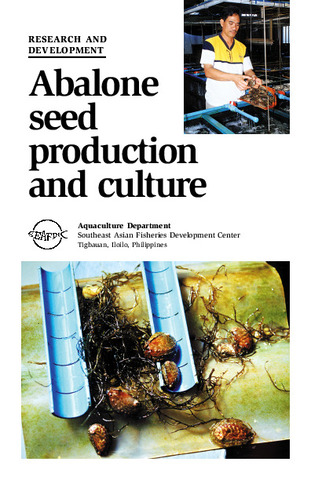
Abalone seed production and culture
(Aquaculture Department, Southeast Asian Fisheries Development Center, 2000)Details the research conducted at AQD for the tropical abalone Haliotis asinina. AQD has developed the rudiments of a hatchery protocol. -
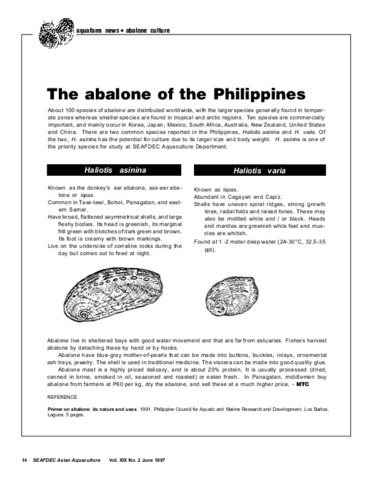
The abalone of the Philippines
(Aquaculture Department, Southeast Asian Fisheries Development Center, 1997) -
Community-based Stock Enhancement of Abalone, Haliotis asinina in Sagay Marine Reserve: Achievements, Limitations and Directions
(Training Department, Southeast Asian Fisheries Development Center, 2016)The Sagay Marine Reserve (SMR) under the National Integrated Protected Area System (NIPAS) is one of the many reef areas in the Visayan Sea in the central part of the Philippine archipelago. The SMR covers 32,000 ha or 59% ...