Use of Acadian marine plant extract powder from Ascophyllum nodosum in tissue culture of Kappaphycus varieties
Quan điểm/
Ngày
2009Page views
543metadata
Hiển thị bản ghi đầy đủ mặt hàngCited times in Scopus
Share
trừu tượng
Three varieties of Kappaphycus alvarezii (Kapilaran, KAP), Tambalang purple (PUR), Adik-adik (AA), and one variety of Kappaphycus striatum var. sacol (green sacol (GS) were used to determine the efficiency of Acadian marine plant extract powder (AMPEP) as a culture medium at different concentrations, for the regeneration of young plants of Kappaphycus varieties, using tissue culture techniques for the production of seed stock for nursery and outplanting purposes for the commercial cultivation of carrageenophytes. A shorter duration for shoot formation was observed when the explant was treated with AMPEP + Plant Growth Regulator (PGR = PAA + zeatin at 1 mg L−1) compared to AMPEP when used singly. However, four explants responded differently to the number of days required for shoot formation. The KAP variety took 46 days to form shoots at 3–4 mg L−1 AMPEP + PGR; while PUR required 21 days at 3–5 mg L−1 AMPEP and 3–4 mg L−1 AMPEP + PGR. AA required 17 days at 3–5 mg L−1 AMPEP and AMPEP + PGR; and GS 25 days at 1 mg L−1 AMPEP + PGR. It was observed that among the four explants used, PUR and AA initiated shoot formation with the use of AMPEP only at higher concentrations (3–5 mg L−1) after a shorter period. Only PUR responded positively to ESS/2 for shoot initiation. The use of AMPEP alone and/or in combination with PGR as a culture medium in the propagation of microplantlets using tissue culture technique is highly encouraging.
Suggested Citation
Hurtado, A. Q., Yunque, D. A., Tibubos, K., & Critchley, A. T. (2009). Use of Acadian marine plant extract powder from Ascophyllum nodosum in tissue culture of Kappaphycus varieties. Journal of Applied Phycology , 21(6), 633-639. https://doi.org/10.1007/s10811-008-9395-4
Chủ thể
Taxonomic term
Bộ sưu tập
- AQD Journal Articles [1249]
Related items
Showing items related by title, author, creator and subject.
-
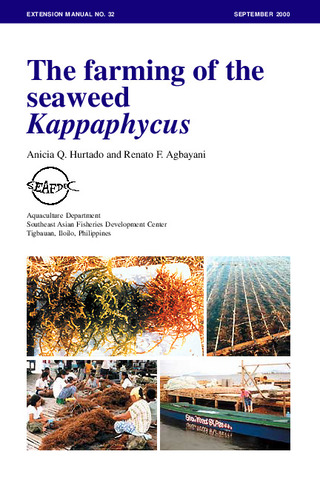
The farming of the seaweed Kappaphycus
(Aquaculture Department, Southeast Asian Fisheries Development Center, 2000)A 24-page manual that introduces the carrageenan-producing seaweed Kappaphycus whose culture has spread from Jolo in Mindanao to at least 14 sites in the Visayas and Luzon. Four culture methods are presented: fixed off-bottom, ... -
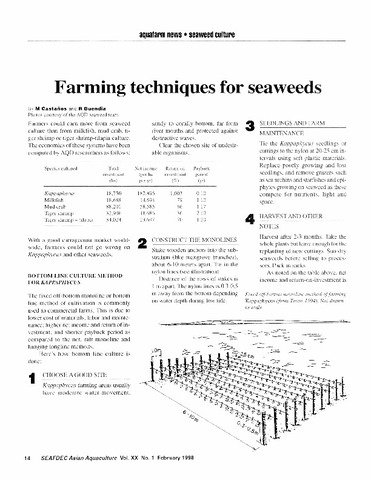
Farming techniques for seaweeds
(Aquaculture Department, Southeast Asian Fisheries Development Center, 1998)Details are given of farming methods developed by the SEAFDEC Aquaculture Department for 3 different seaweeds: 1) Bottom line culture method for Kappaphycus; 2) Pond culture of Gracilaria; and, 3) Gracilariopsis bailinae, ... -
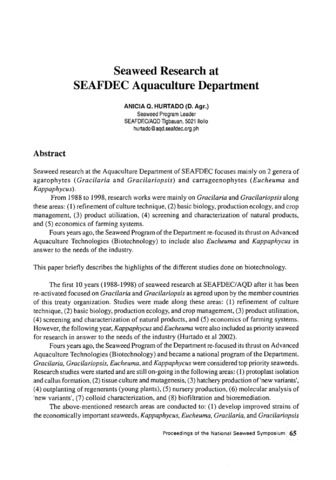
Seaweed research at SEAFDEC Aquaculture Department
(Seaweed Industry Association of the Philippines, 2003)Seaweed research at the Aquaculture Department of SEAFDEC focuses mainly on 2 genera of agarophytes (Gracilaria and Gracilariopsis) and carrageenophytes (Eucheuma and Kappaphycus). From 1988 to 1998, research works were ...