Effects of UV-treated sea water, chlorinated sea water, and formalin-treated copepods on survival and growth of newborn seahorses, Hippocampus comes
Share
စိတ္တဇ
Seed production of the seahorse Hippocampus comes was examined using different types of sea water (UV-treated, chlorinated, sand-filtered), and formalin-treated copepod Pseudodiaptomous sp. as a food organism. Growth and survival of newborn seahorses (8.9±0.0 mm stretched height, 0.004 g) were monitored until day 30 after birth. Growth (stretched height and weight) was significantly higher (p<0.05) in UV-treated sea water (41.4±0.5 mm, 0.23±0.00 g) than in chlorinated (33.8±1.4 mm, 0.16±0.00 g) or sand-filtered (32.8±0.1 mm, 0.16±0.00 g) sea water. Survival was significantly higher in UV-treated (65.6±1.1%) and chlorinated (62.2±4.0%) sea water than in sand-filtered sea water (41.1±1.1%). Survival of seahorses fed 30 ppm formalin-treated copepods (95.3±1.8%) was significantly higher (p<0.05) than of seahorses fed untreated copepods (78.7±5.5%) on day 8. On day 15 survival was 78.7±9.68% in seahorses fed formalin-treated copepods and 0% in those fed untreated copepods. By day 30, survival of seahorses fed formalin-treated copepods was 64.7±9.82%. On the day of the final comparison (day 10), there was no difference in size between groups. Thus, the present study demonstrates that survival and growth of newborn seahorses is significantly improved in UV-treated water, and survival is markedly maintained by treating food organisms in formalin.
Suggested Citation
Buen-Ursua, S. M. A., Azuma, T., Recente, C. P., & Batatin, R. E. (2011). Effects of UV-treated sea water, chlorinated sea water, and formalin-treated copepods on survival and growth of newborn seahorses, Hippocampus comes. The Israeli Journal of Aquaculture-Bamidgeh , 63, 7 pp. http://hdl.handle.net/10862/2112
ဘာသာရပ်
Taxonomic term
စုစည်းမှုများ စုစည်းမှုများ
- AQD Journal Articles [1249]
Related items
Showing items related by title, author, creator and subject.
-
Behaviour of the warm-water mass along the east coast of the Malay Peninsula
(Japan International Cooperation Agency, 1977)A preliminary study was made on oceanographic conditions in the South China Sea, using the data collected over two monsoon seasons. In the northeast monsoon and the subsequent stagnant season, a narrow belt-like water mass ... -
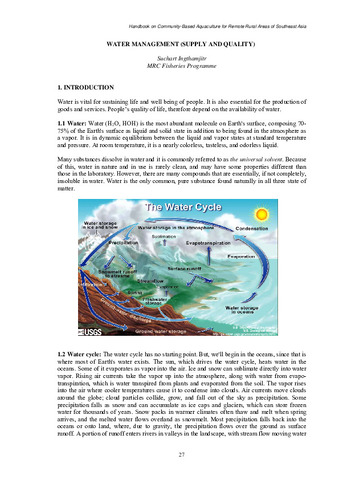
Water management (supply and quality)
(Secretariat, Southeast Asian Fisheries Development Center, 2008)Water (H2O, HOH) is the most abundant molecule on Earth's surface, composing 70- 75% of the Earth's surface as liquid and solid state in addition to being found in the atmosphere as a vapor. It is in dynamic equilibrium ... -
A perspective of the carp industry in the Philippines
(Aquaculture Department, Southeast Asian Fisheries Development Center, 1996)Fish farmers in Laguna de Bay are facing conflict of the use of the lake which is being tapped as freshwater source for domestic use. The article documents the perspectives of some fish farmers and researchers on the ...