Clonal production of Kappaphycus alvarezii (Doty) Doty in vitro
Quan điểm/
Ngày
2017Page views
399metadata
Hiển thị bản ghi đầy đủ mặt hàngCited times in Scopus
Share
trừu tượng
Micropropagation has proven to be a reliable method to mass produce certain crops. This method also has been applied in macroalgae to produce clones for seaweed farming. Protocols for callus production and shoot regeneration from protoplasts have been established for some seaweed species like Kappaphycus alvarezii. Cells and larger tissues, whether in solid or suspension medium, have been used to propagate clones which were later tested for suitability for farming. Although clonal production was successful, the long duration of culture in vitro limits the production process making the growing of Kappaphycus in vitro an expensive technique to produce clones. In this study, K. alvarezii was grown in vitro to develop a more efficient protocol for the production of clones. Small sections of Kappaphycus were grown in suspension for 1 month under the same temperature, light, and salinity. The type of media, source of explants, length of explants, and stocking density that resulted in the highest growth rate and survival rate were determined. Growth rate of K. alvarezii is significantly higher in media with inorganic nitrogen added than in Grund medium or Ascophyllum nodosum medium only. The appearance of shoot primordia as early as 5 days was observed in media with higher nitrogen concentration. Growth rates of explants approximately 3 and 5 mm are significantly higher than 10 mm sections. Shoots develop significantly faster in explants from tips than sections from older branches. Growth rate of K. alvarezii grown at 0.5, 0.75, 1, 1.25 s 10 mL−1 of medium is not significantly different. This protocol could significantly reduce the (1) time of culture and (2) cost of plantlets production by not using plant growth regulators and formulated media in vitro. Nursery reared plantlets/propagules for farming would be affordable to the stakeholders for sustainability of seaweed production.
Suggested Citation
Luhan, M. R. J., & Mateo, J. P. (2017). Clonal production of Kappaphycus alvarezii (Doty) Doty in vitro. Journal of Applied Phycology , 29, 2339-2344. https://doi.org/10.1007/s10811-017-1105-7
Chủ thể
Taxonomic term
Bộ sưu tập
- AQD Journal Articles [1249]
Related items
Showing items related by title, author, creator and subject.
-
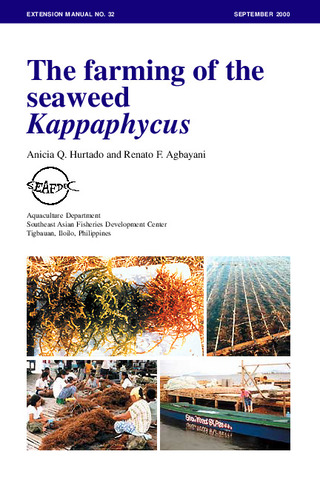
The farming of the seaweed Kappaphycus
(Aquaculture Department, Southeast Asian Fisheries Development Center, 2000)A 24-page manual that introduces the carrageenan-producing seaweed Kappaphycus whose culture has spread from Jolo in Mindanao to at least 14 sites in the Visayas and Luzon. Four culture methods are presented: fixed off-bottom, ... -
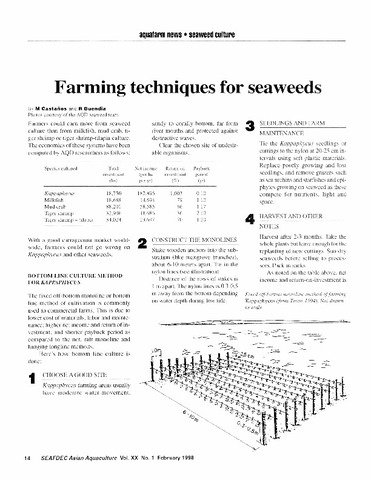
Farming techniques for seaweeds
(Aquaculture Department, Southeast Asian Fisheries Development Center, 1998)Details are given of farming methods developed by the SEAFDEC Aquaculture Department for 3 different seaweeds: 1) Bottom line culture method for Kappaphycus; 2) Pond culture of Gracilaria; and, 3) Gracilariopsis bailinae, ... -
Seaweed research at SEAFDEC Aquaculture Department
(Seaweed Industry Association of the Philippines, 2003)Seaweed research at the Aquaculture Department of SEAFDEC focuses mainly on 2 genera of agarophytes (Gracilaria and Gracilariopsis) and carrageenophytes (Eucheuma and Kappaphycus). From 1988 to 1998, research works were ...