Improvement of Stocking Efficiencies
Share
trừu tượng
This paper focuses on the principal idea or theory of stock enhancement, and the future prospect of 'how to continue the actual activity of stock enhancement in rural areas,' based on the concept of 'Area-Capability'. It should be recalled that an excellent article of Beverton and Holt (1957) on the Dynamics of Exploited Fish Population Dynamics, is the most important reference to be able to understand the effect of fisheries activity of humankind on the fishery resource species. The catch equation of Beverton and Holt (1957) is therefore the principal guiding idea for exploited fishery resources dynamics.
Suggested Citation
Fushimi, H. (2016). Improvement of stocking efficiencies. In H. Kawamura, T. Iwata, Y. Theparoonrat, N. Manajit, & V. T. Sulit (Eds.), Consolidating the Strategies for Fishery Resources Enhancement in Southeast Asia. Proceedings of the Symposium on Strategy for Fisheries Resources Enhancement in the Southeast Asian Region, Pattaya, Thailand, 27-30 July 2015 (pp. 18–24). Samutprakan, Thailand: Training Department, Southeast Asian Fisheries Development Center.
Chủ thể

Related items
Showing items related by title, author, creator and subject.
-
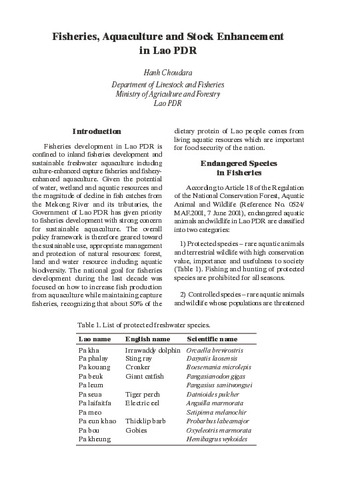
Fisheries, aquaculture and stock enhancement in Lao PDR
(Aquaculture Department, Southeast Asian Fisheries Development Center, 2006)Fisheries development in Lao PDR is confined to inland fisheries development and sustainable freshwater aquaculture including culture-enhanced capture fisheries and fishery-enhanced aquaculture. Given the potential of ... -
Current Status of Fish Stock Enhancement in Thailand
(Training Department, Southeast Asian Fisheries Development Center, 2016)Aquatic animals from natural waters have long been exploited by rural poor as cheap protein food. Natural waters including rivers, canals, swamps, lakes, large reservoirs, and small water bodies are significantly exploited ... -
Status of Fishing Conditions in Japan in Relation to Responsible Fisheries
(Training Department, Southeast Asian Fisheries Development Center, 1997)The presence of a large number of species that are low in quantity in Japan's coastal waters has resulted in the evolution of a food culture that has historically utilized most of the catch species and sizes that are caught ...