Country status on sustainable aquaculture in Lao PDR
Share
trừu tượng
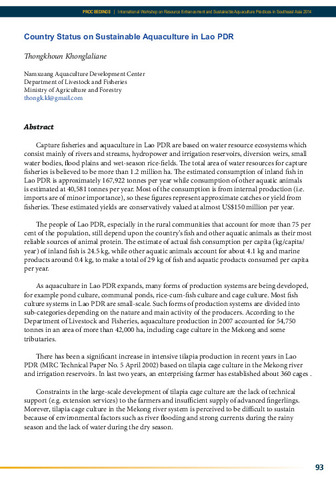
Capture fisheries and aquaculture in Lao PDR are based on water resource ecosystems which consist mainly of rivers and streams, hydropower and irrigation reservoirs, diversion weirs, small water bodies, flood plains and wet-season rice-fields. The total area of water resources for capture fisheries is believed to be more than 1.2 million ha. The estimated consumption of inland fish in Lao PDR is approximately 167,922 tonnes per year while consumption of other aquatic animals is estimated at 40,581 tonnes per year. Most of the consumption is from internal production (i.e. imports are of minor importance), so these figures represent approximate catches or yield from fisheries. These estimated yields are conservatively valued at almost US$150 million per year.
The people of Lao PDR, especially in the rural communities that account for more than 75 per cent of the population, still depend upon the country's fish and other aquatic animals as their most reliable sources of animal protein. The estimate of actual fish consumption per capita (kg/capita/ year) of inland fish is 24.5 kg, while other aquatic animals account for about 4.1 kg and marine products around 0.4 kg, to make a total of 29 kg of fish and aquatic products consumed per capita per year.
As aquaculture in Lao PDR expands, many forms of production systems are being developed, for example pond culture, communal ponds, rice-cum-fish culture and cage culture. Most fish culture systems in Lao PDR are small-scale. Such forms of production systems are divided into sub-categories depending on the nature and main activity of the producers. According to the Department of Livestock and Fisheries, aquaculture production in 2007 accounted for 54,750 tonnes in an area of more than 42,000 ha, including cage culture in the Mekong and some tributaries.
There has been a significant increase in intensive tilapia production in recent years in Lao PDR (MRC Technical Paper No. 5 April 2002) based on tilapia cage culture in the Mekong river and irrigation reservoirs. In last two years, an enterprising farmer has established about 360 cages.
Constraints in the large-scale development of tilapia cage culture are the lack of technical support (e.g. extension services) to the farmers and insufficient supply of advanced fingerlings. Morever, tilapia cage culture in the Mekong river system is perceived to be difficult to sustain because of environmental factors such as river flooding and strong currents during the rainy season and the lack of water during the dry season.
Suggested Citation
Khonglaliane, T. (2015). Country status on sustainable aquaculture in Lao PDR. In M. R. R. Romana-Eguia, F. D. Parado-Estepa, N. D. Salayo, & M. J. H. Lebata-Ramos (Eds.), Resource Enhancement and Sustainable Aquaculture Practices in Southeast Asia: Challenges in Responsible Production of Aquatic Species: Proceedings of the International Workshop on Resource Enhancement and Sustainable Aquaculture Practices in Southeast Asia 2014 (RESA) (pp. 93-94). Tigbauan, Iloilo, Philippines: Aquaculture Department, Southeast Asian Fisheries Development Center.
Chủ thể

Related items
Showing items related by title, author, creator and subject.
-
The Status of Fisheries in the Republic of Maldives
(Training Department, Southeast Asian Fisheries Development Center, 1997)The paper discusses the tuna fisheries in Maldives which dominates its fishing industry. Apart from a very strong domestic market, tuna is also the main export commodity of the country. Moreover, reef fisheries such as, ... -
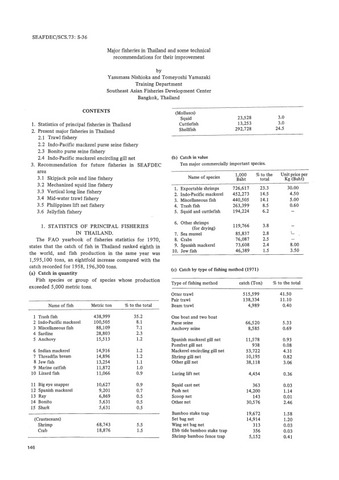
Major fisheries in Thailand and some technical recommendations for their improvement
(Japan International Cooperation Agency, 1977)Presented in this paper is the development of fisheries industry in Thailand. The data on the production of the principal fisheries species and major fishing methods are also presented. Also included are the recommendations ... -
Status of Fishing Conditions in Cambodia
(Training Department, Southeast Asian Fisheries Development Center, 1997)Fisheries in plays a very important role in Cambodia’s national economic development. Total fish catch production in 1996 was 104 310 tones, about which 60% was contributed by inland capture fisheries, 30% by marine capture ...