SEAFDECINSTITUTIONAL REPOSITORY
    • English
    • ไทย
    • 日本語
    • Bahasa Indonesia
    • Bahasa Melayu
    • Burmese
    • Filipino
    • Khmer
    • Lao
    • Tiếng Việt
  • Filipino 
    • English
    • ไทย
    • 日本語
    • Bahasa Indonesia
    • Bahasa Melayu
    • Burmese
    • Filipino
    • Khmer
    • Lao
    • Tiếng Việt
  • Mag log in
Tingnan ang Item 
  •   DSpace Home
  • 01 SEAFDEC Publications
  • 11 Conference Proceedings
  • SEAFDEC/AQD Conference Proceedings
  • Aquatic Emergency Preparedness and Response Systems for Effective Management of Transboundary Disease Outbreaks in Southeast Asia (AEPRS)
  • Tingnan ang Item
  •   DSpace Home
  • 01 SEAFDEC Publications
  • 11 Conference Proceedings
  • SEAFDEC/AQD Conference Proceedings
  • Aquatic Emergency Preparedness and Response Systems for Effective Management of Transboundary Disease Outbreaks in Southeast Asia (AEPRS)
  • Tingnan ang Item
JavaScript is disabled for your browser. Some features of this site may not work without it.

Emergency response to emerging disease: AHPND in shrimp
Thumbnail
Tingnan/Open
SritunyalucksanaK2019.pdf (71.24Kb)
Petsa
2019
May-akda
Sritunyalucksana, Kallaya
Flegel, Timothy W.
Sithigorngul, Paisarn
Wangman, Pradit
Page views
579
Metadata
Ipakita ang buong tala ng item

Share 
 
Abstract
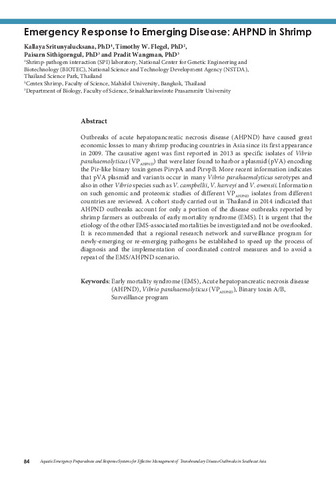
Outbreaks of acute hepatopancreatic necrosis disease (AHPND) have caused great economic losses to many shrimp producing countries in Asia since its first appearance in 2009. The causative agent was first reported in 2013 as specific isolates of Vibrio parahaemolyticus (VPAHPND) that were later found to harbor a plasmid (pVA) encoding the Pir-like binary toxin genes PirvpA and PirvpB. More recent information indicates that pVA plasmid and variants occur in many Vibrio parahaemolyticus serotypes and also in other Vibrio species such as V. campbellii, V. harveyi and V. owensii. Information on such genomic and proteomic studies of different VPAHPND isolates from different countries are reviewed. A cohort study carried out in Thailand in 2014 indicated that AHPND outbreaks account for only a portion of the disease outbreaks reported by shrimp farmers as outbreaks of early mortality syndrome (EMS). It is urgent that the etiology of the other EMS-associated mortalities be investigated and not be overlooked. It is recommended that a regional research network and surveillance program for newly-emerging or re-emerging pathogens be established to speed up the process of diagnosis and the implementation of coordinated control measures and to avoid a repeat of the EMS/AHPND scenario.
URI
http://hdl.handle.net/10862/3469
Suggested Citation
Sritunyalucksana, K., Flegel, T. W., Sithigorngul, P., & Wangman, P. (2019). Emergency response to emerging disease: AHPND in shrimp. In E. A. Tendencia, L. D. de la Peña, & J. M. V. de la Cruz (Eds.), Aquatic Emergency Preparedness and Response Systems for Effective Management of Transboundary Disease Outbreaks in Southeast Asia: Proceedings of Asean Regional Technical Consultation, 20-22 August 2018, Centara Grand Central Ladprao, Bangkok, Thailand (p. 84). Tigbauan, Iloilo, Philippines: Aquaculture Department, Southeast Asian Fisheries Development Center.
Paksa
genes ASFA; hepatopancreas ASFA; aetiology ASFA; Necroses; pathogens ASFA; plasmids ASFA; economics ASFA; cohorts ASFA; diseases ASFA; countries ASFA
Mga koleksyon
  • Aquatic Emergency Preparedness and Response Systems for Effective Management of Transboundary Disease Outbreaks in Southeast Asia (AEPRS) [20]

© SEAFDEC 2025
Makipag-ugnayan sa amin


Mag-browse

Lahat ng DSpaceMga Komunidad at KoleksyonAyon sa Petsa ng IsyuMga may-akdaMga pamagatMga paksaAng Koleksyon na itoAyon sa Petsa ng IsyuMga may-akdaMga pamagatMga paksa

Aking Account

Mag log in
Related Links
SEAFDEC/TD IRSEAFDEC/AQD IRSEAFDEC/MFRDMD IRSEAFDEC/IFRDMD IR

© SEAFDEC 2025
Makipag-ugnayan sa amin