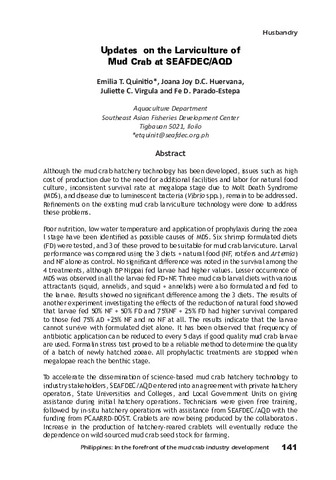
Updates on the larviculture of mud crab at SEAFDEC/AQD
Share
trừu tượng
Although the mud crab (Scylla serrata) hatchery technology has been developed, issues such as high cost of production due to the need for additional facilities and labor for natural food culture, inconsistent survival rate at megalopa stage due to Molt Death Syndrome (MDS), and disease due to luminescent bacteria (Vibrio spp.), remain to be addressed. Refinements on the existing mud crab larviculture technology were done to address these problems.Poor nutrition, low water temperature and application of prophylaxis during the zoea l stage have been identified as possible causes of MDS. Six shrimp formulated diets (FD) were tested, and 3 of these proved to be suitable for mud crab larvicuture. Larval performance was compared using the 3 diets + natural food (NF, rotifers and Artemia) and NF alone as control. No significant difference was noted in the survival among the 4 treatments, although BP Nippai fed larvae had higher values. Lesser occurrence of MDS was observed in all the larvae fed FD+NF. Three mud crab larval diets with various attractants (squid, annelids, and squid + annelids) were also formulated and fed to the larvae. Results showed no significant difference among the 3 diets. The results of another experiment investigating the effects of the reduction of natural food showed that larvae fed 50% NF + 50% FD and 75%NF + 25% FD had higher survival compared to those fed 75% AD +25% NF and no NF at all. The results indicate that the larvae cannot survive with formulated diet alone. It has been observed that frequency of antibiotic application can be reduced to every 5 days if good quality mud crab larvae are used. Formalin stress test proved to be a reliable method to determine the quality of a batch of newly hatched zoeae. All prophylactic treatments are stopped when megalopae reach the benthic stage.To accelerate the dissemination of science-based mud crab hatchery technology to industry stakeholders, SEAFDEC/AQD entered into an agreement with private hatchery operators, State Universities and Colleges, and Local Government Units on giving assistance during initial hatchery operations. Technicians were given free training, followed by in-situ hatchery operations with assistance from SEAFDEC/AQD with the funding from PCAARRD-DOST. Crablets are now being produced by the collaborators. Increase in the production of hatchery-reared crablets will eventually reduce the dependence on wild-sourced mud crab seed stock for farming.
Sự miêu tả
Abstract only.
Suggested Citation
Quinitio, E. T., Huervana, J. J. D. C., Virgula, J. C., & Parado-Estepa, F. D. (2017). Updates on the larviculture of mud crab at SEAFDEC/AQD. In E. T. Quinitio, F. D. Parado-Estepa, & R. M. Coloso (Eds.), Philippines : In the forefront of the mud crab industry development : proceedings of the 1st National Mud Crab Congress, 16-18 November 2015, Iloilo City, Philippines (p. 141). Tigbauan, Iloilo, Philippines: Aquaculture Department, Southeast Asian Fisheries Development Center.
Chủ thể
bacterial diseases  ; stress ; crab culture ; crustacean larvae ; feeds ; feeding experiments ; cultured organisms; hatcheries; husbandry diseases; marine crustaceans ; nutritional disorders ; disease prophylaxis ; survival ; viral diseases ; water temperature ; zoeae ; Artemia ; Scylla serrata ; Philippines
; stress ; crab culture ; crustacean larvae ; feeds ; feeding experiments ; cultured organisms; hatcheries; husbandry diseases; marine crustaceans ; nutritional disorders ; disease prophylaxis ; survival ; viral diseases ; water temperature ; zoeae ; Artemia ; Scylla serrata ; Philippines
Taxonomic term

Related items
Showing items related by title, author, creator and subject.
-
Health management in aquaculture
(Aquaculture Department, Southeast Asian Fisheries Development Center, 2010-07)A textbook on diseases of cultured warmwater fish and shrimps in the Philippines. Eleven chapters cover essential information on the basic principles of disease causation, major diseases of cultured fish and crustaceans, ... -
Country status of aquatic emergency preparedness and response systems for effective management of aquatic animal disease outbreaks in Myanmar
(Aquaculture Department, Southeast Asian Fisheries Development Center, 2019)Myanmar is one of the OIE members and the Department of Fisheries (DoF) is highly concerned with transboundary aquatic animal pathogens. Therefore, the Aquatic Animal Health & Disease Control Section has already been ... -
Health management in aquaculture
(Aquaculture Department, Southeast Asian Fisheries Development Center, 2001)A textbook on diseases of cultured warmwater fish and shrimps in the Philippines. Eleven chapters cover essential information on the basic principles of disease causation, major diseases of cultured fish and crustaceans, ...