Application of remote sensing in fisheries
Share
Abstract
The remote sensing techniques is used to study the distribution of fish in relation with the oceanic phenomena such as sea surface temperature (SST) and ocean color (phytoplankton). The pelagic fishing data were analysed from May 1997 to August 1998. The satellite data from NOAA AVHRR (SST) and SeaWiFS (phytoplankton) were also analysed. The results show that a lot of pelagic fish were caught in the warm water fronts as well as in the area of high density of phytoplankton. Further analyses should be made to come out with the firmer conclusion.
Suggested Citation
Yaacob, K. K. K. (2000). Application of remote sensing in fisheries. In Report of the Fourth Regional Workshop on Shared Stocks: Research and Management in the South China Sea (pp. 236-256). Kuala Terengganu, Malaysia: Marine Fishery Resources Development and Management Department, Southeast Asian Fisheries Development Center.
Subject

Related items
Showing items related by title, author, creator and subject.
-
The Status of Fisheries in the Republic of Maldives
(Training Department, Southeast Asian Fisheries Development Center, 1997)The paper discusses the tuna fisheries in Maldives which dominates its fishing industry. Apart from a very strong domestic market, tuna is also the main export commodity of the country. Moreover, reef fisheries such as, ... -
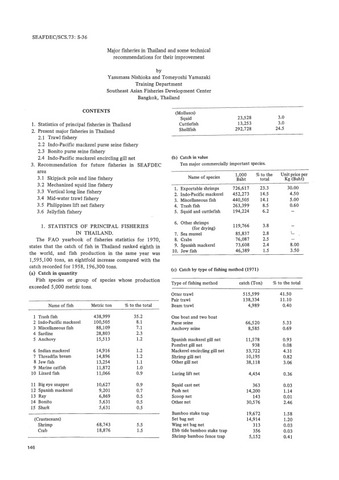
Major fisheries in Thailand and some technical recommendations for their improvement
(Japan International Cooperation Agency, 1977)Presented in this paper is the development of fisheries industry in Thailand. The data on the production of the principal fisheries species and major fishing methods are also presented. Also included are the recommendations ... -
Status of Fishing Conditions in Cambodia
(Training Department, Southeast Asian Fisheries Development Center, 1997)Fisheries in plays a very important role in Cambodia’s national economic development. Total fish catch production in 1996 was 104 310 tones, about which 60% was contributed by inland capture fisheries, 30% by marine capture ...