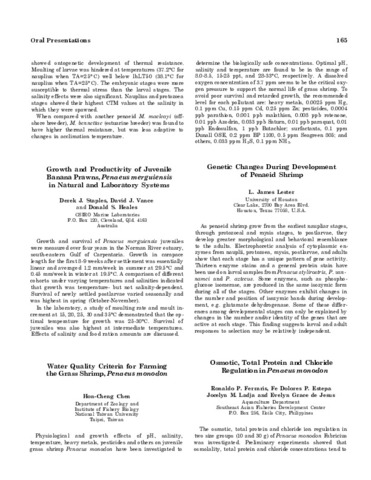
Osmotic, total protein and chloride regulation in Penaeus monodon
Share
trừu tượng
The osmotic, total protein and chloride ion regulation in two size groups (10 and 30 g) of Penaeus monodon Fabricius was investigated. Preliminary experiments showed that osmolality, total protein and chloride concentrations tend to become stable 24 to 36 hours after molting.Thus,hemolymph values 36 to 240 hours after sampling were not significantly different from each other. Based on these results, only 36 hours (or more) postmolt animals were sampled after transfer from control (32 ppt) to five test salinities (8, 16, 24, 32 and 40 ppt). Hemolymph samples were then taken 1, 2, 3, 5, 7 and 10 days after transfer. Results showed that in general, osmolality, total protein and chloride concentrations in the hemolymph did not vary with time within the same salinity.Both sizes exhibited hyperosmotic and hyperionic regulation in lower salinities and hypoosmotic and hypoionic regulation in higher salinities. The isosmotic values obtained were approximately 676 to 720 mOsm (24 to 28.8 ppt) for the 10 g, and 724 to 792 mOsm (26 to 28.5 ppt) for the 30 g size group. For chloride, the isoionic values ranged from 324 to 339 mM in 10 g prawns. Slopes of the regression lines of hemolymph osmolality versus salinity in 10 g prawns were not significantly different from slopes of similar regression lines in 30 g prawns. These results suggest that the ability to regulate osmotic and total protein concentration in the hemolymph is similar in the two size groups.
Sự miêu tả
Abstract only.
Suggested Citation
Ferraris, R. P., Estepa, F. D. P., Ladja, J. M., & de Jesus, E. G. (1985). Osmotic, total protein and chloride regulation in Penaeus monodon (Abstract only). In Taki Y., Primavera J.H. and Llobrera J.A. (Eds.). Proceedings of the First International Conference on the Culture of Penaeid Prawns/Shrimps, 4-7 December 1984, Iloilo City, Philippines (pp. 165-166). Iloilo City, Philippines:Aquaculture Department, Southeast Asian Fisheries Development Center.
Taxonomic term

Related items
Showing items related by title, author, creator and subject.
-
An overview of the nutrition, feed and feeding techniques of prawn penaeid/shrimps
(Philippine Council for Aquatic and Marine Research and Development, 1989)This paper echoes what transpired during the first International Conference of Penaeid Prawns/Shrimps held in Iloilo City in December 4-7, 1984, particularly on the Nutrition nd Feed Development. Around 25 papers were ... -
Prawn hatchery operations
(Aquaculture Department, Southeast Asian Fisheries Development Center, 1996-05)The manual, an updated version of the 1984 SEAFDEC/AQD manual, presents the underlying principles and step-by-step instructions of prawn larval and post-larval rearing. The techniques described are not only applicable to ... -
The lowdown on world shrimp culture - II
(INFOFISH, 2001)This paper introduces some new members of the international shrimp culture club and goes on to discuss some recent technological innovations in the industry, particularly the polyculture of tilapia (mainly Oreochromis ...