Population structure of the brown-banded bamboo shark, Chiloscyllium punctatum and its relation to fisheries management in the Indo-Malay region
Quan điểm/
Request this document
Ngày
2021-08Page views
564metadata
Hiển thị bản ghi đầy đủ mặt hàngCited times in Scopus
Share
trừu tượng
The brown-banded bamboo shark, Chiloscyllium punctatum is one of the most common shark species caught in coastal fisheries throughout the Indo-Malay region and the most abundant shark caught in trawl fisheries in Malaysia and Thailand. Differences in fisheries regulations related to trawling among jurisdictions, and an absence of either stock assessments or population estimates in the region, raise questions about the sustainability of fisheries that take this species. As a small-bodied, benthic shark that predominantly inhabits shallow, soft substrate habitats, the population may be particularly vulnerable to trawling throughout the region. We investigated the population structure of Chiloscyllium punctatum using genome-wide nuclear markers. Comprehensive DNA sampling was undertaken in Thailand, Malaysia and Indonesia, and population structure analysis using SNP datasets revealed at least four genetically distinct regional groups of C. punctatum. We identified a potentially shared stock between Malaysia and Indonesia, and separate populations in the Andaman Sea off Thailand, the South China Sea, and a localized population in South Sulawesi, Indonesia. Each of these stocks may likely require different management approaches tailored to the scale and types of fishing pressure in the different regions.
Sự miêu tả
Keywords
Shared stock SNPs Coastal fisheries Bamboo sharkSuggested Citation
Fahmi, Tibbetts, I. R., Bennett, M. B., Ali, A., Krajangdara, T., & Dudgeon, C. L. (2021). Population structure of the brown-banded bamboo shark, Chiloscyllium punctatum and its relation to fisheries management in the Indo-Malay region. Fisheries Research , 240, 105972. https://doi.org/10.1016/j.fishres.2021.105972
Chủ thể


Taxonomic term

Bộ sưu tập
Related items
Showing items related by title, author, creator and subject.
-
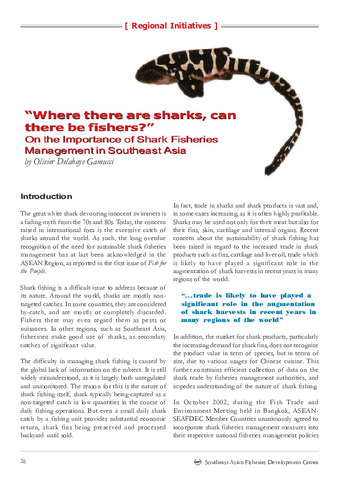
"Where there are sharks, can there be fishers?" On the importance of shark fisheries management in Southeast Asia
(Secretariat, Southeast Asian Fisheries Development Center, 2003)An overview on the importance of shark fisheries management in Southeast Asia is given. In particular recent progress in the region, status and trends of shark fisheries, utilization and trade of shark are given. -
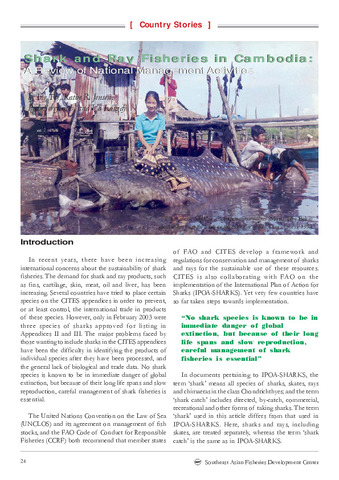
Shark and ray fisheries in Cambodia: A review of national management activities
(Secretariat, Southeast Asian Fisheries Development Center, 2004)Cambodia is both a signatory party to CITES and a member of FAO, and thus is required to implement a national plan of action for the conservation and sustainable use of shark and ray resources. But at the national level ... -
Paving the way for the development of non-detriment findings: Towards precise species identification of sharks and rays in Southeast Asia
(Secretariat, Southeast Asian Fisheries Development Center, 2019)CITES defines non-detriment finding as “a conclusion by a Scientific Authority that the export of specimens of a particular species will not impact negatively on the survival of that species in the wild. The non-detriment ...