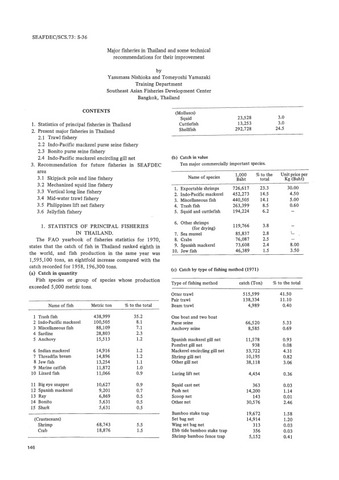
Challenges balancing fisheries resource management and river development in Indonesia
ดู/
Request this document
วันที่
2019-07-18Page views
662เมตาดาต้า
แสดงระเบียนรายการเต็มCited times in Scopus
Share
นามธรรม
Indonesia’s increasing human population will require more food and potable water into the future. Constructing more reservoirs has been deemed a national priority to help meet these basic needs. The number of reservoirs in Indonesia has increased gradually over time, but this may have affected fisheries resources. Of the 100 reservoirs already built, 80% are on the island of Java. The direct effects of reservoir on fisheries resources include sedimentation, reduced water flows, eutrophication and disturbance to the fish life cycle, and indirect effects may include overfishing. Reservoirs can also alter habitat, which can change fisheries productivity. Fisheries resources management, in a reservoir, has a high possibility of success if clear boundaries are set and expectations are managed. Fishermen need to participate in management and targets must be set to establish a complete ecosystem for a growing fish population. Other interventions, such as floating cage aquaculture and fish restocking, are suitable tools for management. However, at present there is no Indonesian framework to guide such management tools. With many more reservoirs planned into the future, there is a pressing need to develop a systematic and robust management system to ensure fisheries and river development can coexist.
Keywords
opportunities reservoirs successการอ้างอิง
Utomo, A. D., Wibowo, A., Suhaimi, R. A., Atminarso, D., & Baumgartner, L. (2019). Challenges balancing fisheries resource management and river development in Indonesia. Marine and Freshwater Research , 70(9), 1265-1273. https://doi.org/10.1071/MF19160
DOI
10.1071/MF19160เรื่อง


คอลเลกชัน
รายการที่เกี่ยวข้อง
แสดงรายการที่เกี่ยวข้องตามชื่อผู้แต่งผู้สร้างและเรื่อง
-
The Status of Fisheries in the Republic of Maldives
(Training Department, Southeast Asian Fisheries Development Center, 1997)The paper discusses the tuna fisheries in Maldives which dominates its fishing industry. Apart from a very strong domestic market, tuna is also the main export commodity of the country. Moreover, reef fisheries such as, ... -
Major fisheries in Thailand and some technical recommendations for their improvement
(Japan International Cooperation Agency, 1977)Presented in this paper is the development of fisheries industry in Thailand. The data on the production of the principal fisheries species and major fishing methods are also presented. Also included are the recommendations ... -
Status of Fishing Conditions in Cambodia
(Training Department, Southeast Asian Fisheries Development Center, 1997)Fisheries in plays a very important role in Cambodia’s national economic development. Total fish catch production in 1996 was 104 310 tones, about which 60% was contributed by inland capture fisheries, 30% by marine capture ...