Boosting the sustainability of aquaculture feed for the lucrative business of mangrove crab grow-out culture
Share
抄録
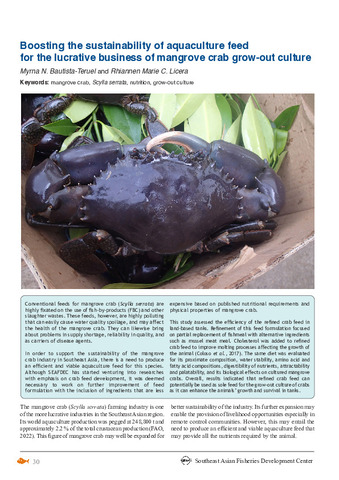
Conventional feeds for mangrove crab (Scylla serrata) are highly fixated on the use of fish-by-products (FBC) and other slaughter wastes. These feeds, however, are highly polluting that can easily cause water quality spoilage, and may affect the health of the mangrove crab. They can likewise bring about problems in supply shortage, reliability in quality, and as carriers of disease agents.
In order to support the sustainability of the mangrove crab industry in Southeast Asia, there is a need to produce an efficient and viable aquaculture feed for this species. Although SEAFDEC has started venturing into researches with emphasis on crab feed development, it was deemed necessary to work on further improvement of feed formulation with the inclusion of ingredients that are less expensive based on published nutritional requirements and physical properties of mangrove crab.
This study assessed the efficiency of the refined crab feed in land-based tanks. Refinement of this feed formulation focused on partial replacement of fishmeal with alternative ingredients such as mussel meat meal. Cholesterol was added to refined crab feed to improve molting processes affecting the growth of the animal (Coloso et al., 2017). The same diet was evaluated for its proximate composition, water stability, amino acid and fatty acid compositions, digestibility of nutrients, attractability and palatability, and its biological effects on cultured mangrove crabs. Overall, results indicated that refined crab feed can potentially be used as sole feed for the grow-out culture of crabs as it can enhance the animals’ growth and survival in tanks.
Suggested Citation
Bautista-Teruel, M. N., & Licera, R. M. C. (2023). Boosting the sustainability of aquaculture feed for the lucrative business of mangrove crab grow-out culture. Fish for the People , 21(2), 30-34. http://hdl.handle.net/20.500.12066/7430
主題

Taxonomic term

Collections
Related items
Showing items related by title, author, creator and subject.
-
Updates on the seed production of mud crab
(Aquaculture Department, Southeast Asian Fisheries Development Center, 2015)Widespread interest in mud crab species is increasing because these are highly prized both in domestic and export markets. Among the three mud crab species commonly found in the Philippines, Scylla serrata, S. olivacea, ... -
Aqua-mangrove integrated farming: Shrimp and mud crab culture in coastal and inland tidal flats with existing reforested or natural growth of mangroves
(Aquaculture Department, Southeast Asian Fisheries Development Center, 2000)Throughout the tropics, mangroves are being destroyed at an increasing rate for the development of aquaculture ponds. In the Philippines, for instance, mangroves were about 400,000 to 500,000 ha in 1918 but were reduced ... -
Nursery culture of mud crab, Scylla serrata, using different ratios of natural food to formulated feed
(Aquaculture Department, Southeast Asian Fisheries Development Center, 2017)The effect of feeding different ratios of natural food to formulated feed on the production and profitability of Phases 1 and 2 of nursery culture (3 weeks per phase) of hatchery-produced crab Scylla serrata was investigated. ...