
Advocating preventive measures that inhibit early mortality syndrome in shrimps
Share
អរូបី
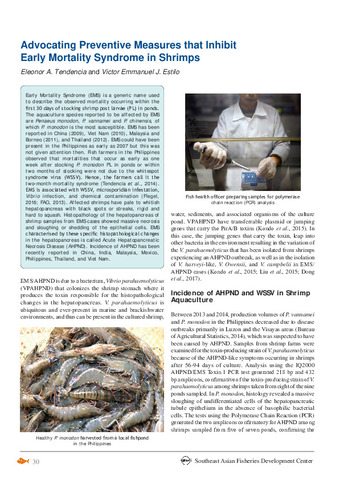
Early Mortality Syndrome (EMS) is a generic name used to describe the observed mortality occurring within the first 30 days of stocking shrimp (Penaeus sp.) post larvae (PL) in ponds. The aquaculture species reported to be affected by EMS are Penaeus monodon, P. vannamei and P. chinensis, of which P. monodon is the most susceptible. EMS has been reported in China (2009), Viet Nam (2010), Malaysia and Borneo (2011), and Thailand (2012). EMS could have been present in the Philippines as early as 2007 but this was not given attention then. Fish farmers in the Philippines observed that mortalities that occur as early as one week after stocking P. monodon PL in ponds or within two months of stocking were not due to the whitespot syndrome virus (WSSV). Hence, the farmers call it the two-month mortality syndrome (Tendencia et al., 2014). EMS is associated with WSSV, microsporidian infestation, Vibrio infection, and chemical contamination (Flegel, 2016; FAO, 2013). Affected shrimps have pale to whitish hepatopancreas with black spots or streaks, rigid and hard to squash. Histopathology of the hepatopancreas of shrimp samples from EMS cases showed massive necrosis and sloughing or shedding of the epithelial cells. EMS characterised by these specific histopathological changes in the hepatopancreas is called Acute Hepatopancreatic Necrosis Disease (AHPND). Incidence of AHPND has been recently reported in China, India, Malaysia, Mexico, Philippines, Thailand, and Viet Nam.
Suggested Citation
Tendencia, E. A., & Estilo, V. E. J. (2017). Advocating preventive measures that inhibit early mortality syndrome in shrimps. Fish for the People , 15(3), 30-36. http://hdl.handle.net/20.500.12066/1282
ប្រធានបទ
fish  ; larvae ; aquaculture ; infestation ; mortality ; histopathology ; hepatopancreas ; Necroses; ponds ; marine crustaceans ; Penaeus; South East Asia
; larvae ; aquaculture ; infestation ; mortality ; histopathology ; hepatopancreas ; Necroses; ponds ; marine crustaceans ; Penaeus; South East Asia