Selection, transport and acclimation of prawn fry
Share
Abstract
The most important criterion among many used by operators for choosing poostlarvae to stock in ponvds, is the stage of development. THe stages considered suitable for stocking (about PL20) can be identified by examination of anatomical features including the rostal spine number, the length of carapace and sixth abdominal segment. Pigmentation in uropods, size uniformity and activity of post larvae are useful considerations. During Transport,decreasing water temperature to lwer metabolic rate helps ensure the adequacy of oxygen in bags. Upon stocking, acclimation to the temperature and salinity of pond water is very importan. If changes are sudden, regulatory mechanisms may fail, resulting in moralities.
Suggested Citation
Parado-Estepa, F. D. (1988). Selection, transport and acclimation of prawn fry. In Y. N. Chiu, L. M. Santos, & R. O. Juliano (Eds.), Technical Considerations for the Management and Operation of Intensive Prawn Farms (pp. 81–85). Iloilo City, Philippines: U.P. Aquaculture Society.
Paksa

Taxonomic term

Mga koleksyon
Related items
Showing items related by title, author, creator and subject.
-
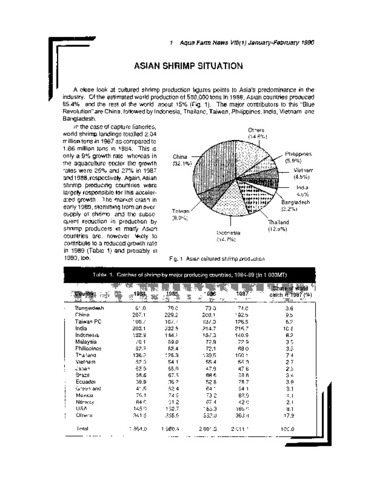
Asian shrimp situation
(Aquaculture Department, Southeast Asian Fisheries Development Center, 1990) -
Cooperative Research Networking to Facilitate Research and Development for the Reduction of Wastage in Shrimp Fisheries
(Training Department, Southeast Asian Fisheries Development Center, 1997)Because of the importance of shrimp trawling fisheries in a number of countries in Asia and the Indian Ocean region and recommendations for more research work in the field of selectivity, in particular through more cooperation ... -
Seagrass Bed Restoration by Fishermen at Hinase in Japan
(Training Department, Southeast Asian Fisheries Development Center, 2016)Habitat rehabilitation which is very important for fishery resources enhancement should be conducted following the community-based management and ecosystem-based management. In Japan, the Satoumi concept is introduced as ...